



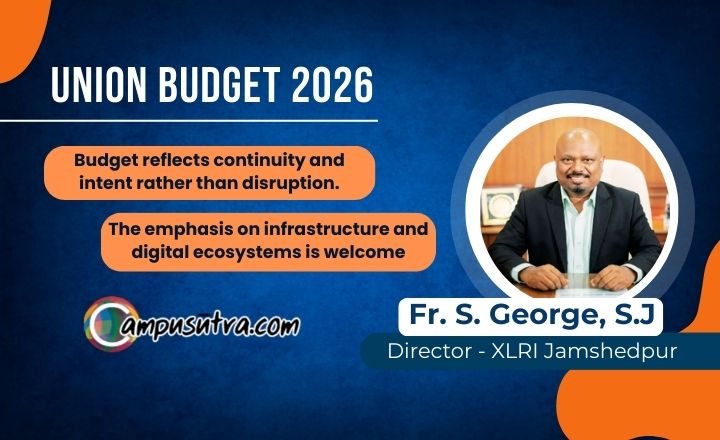
The Union Budget 2026-27 always carries a dual expectation addressing immediate national priorities while laying the foundation for long-term capacity building. From the standpoint of higher education and particularly institutions committed to nation-building, the Budget signals intent but also reveals the distance yet to be covered.
On employability and the Professors of Practice (PoP) initiative, the direction is encouraging. Formal recognition of industry practitioners within academia can meaningfully narrow the industry–academia gap. However, for this to translate into real impact, institutions require sustained funding flexibility, clear appointment frameworks and incentives that make long-term engagement attractive for seasoned professionals. Without these enablers, PoP risks remain symbolic rather than transformative.
The emphasis on infrastructure and digital ecosystems is welcome, especially in expanding connectivity and digital platforms. For the common citizen, this promises greater access to education and skill development. Yet for HEIs, the challenge lies not merely in connectivity but in depth of digital integration, smart classrooms, secure research data environments and advanced computing infrastructure. These require targeted investments beyond baseline digital access.
On research and facilities, the gap between aspiration and reality becomes more evident. While incremental allocations help, India still invests significantly less in higher education research compared to nations such as China or leading developed economies. If Indian institutions are to evolve into global hubs of original research rather than primarily teaching institutions, there must be bold, long-term funding for doctoral education, research infrastructure, interdisciplinary centres and sustained grants not only project-based or short-cycle support.
The cost of education remains a concern for families. While affordability measures exist, the increasing reliance on self-financed models places pressure on both institutions and students. Ensuring quality without making education exclusionary will require innovative public–private models and targeted student support mechanisms.
A long-standing expectation that public spending on education would move decisively towards 6% of GDP remains unmet. The absence of a clear roadmap toward this goal is perhaps the one bold move many in academia hoped to see. Similarly, while AI integration is widely discussed, dedicated budgetary support to ensure digital equity in tier-2 and tier-3 regions remains limited, risking a new divide in quality education.
In sum, the Budget reflects continuity and intent rather than disruption. It provides incremental support but stops short of the decisive investments required to make Indian higher education globally competitive. Bridging the industry–academia gap and serving the common citizen will demand not just policy announcements but sustained, courageous investment in people, research and institutional capacity.
Also read what Directors / Deans of other B Schools had to say.
-
What does the Union Budget 2026-2027 mean to Higher Education? ~ By Prof. (Dr.) V. Jayashree Director, VVISM Hyderabad
-
Union Budget 2026: Nirmala Sitharaman to Engage With Students Post-Budget Presentation
-
From Manpower Supplier to Skill Superpower: Why India Must Invest in Merit ~ Prof B C Patnaik Director NIA Pune
-
Union Budget 2026 – “Human capital at the centre of India’s growth story” – Dr. Debashis Chatterjee, Director, IIM Kozhikode
-
Union Budget 2026 and Indian Education: Vision with Velocity, But Not Yet at Scale ~By Ravi Kumar Jain, Pro Vice Chancellor / Director, School of Management, IILM University, Gurugram.
-
Budget 2026–27: Turning Education, Healthcare and Innovation into India’s Long-Term Growth Engine


