


International Literacy Day 2026: As the world observes International Literacy Day on September 8, India’s improving literacy figures highlight the progress made in education while also bringing attention to the challenges that remain beyond access to classrooms.
This year marks the 60th anniversary of International Literacy Day, with the theme “Literacy for people, the planet and prosperity.” The theme calls for a closer look at the progress made so far, the challenges that continue to affect literacy and how education systems can respond to a rapidly changing world.
Globally, the challenge remains significant. According to UNESCO, 739 million youth and adults lacked basic literacy skills in 2024, while four in 10 children were not achieving minimum proficiency in reading. In 2023, 272 million children and adolescents were out of school.
India, meanwhile, has recorded an improvement in its literacy rate, which reportedly rose to 81% in 2024 from 77% in 2023. Union Education Minister Pralhad Joshi, marking the occasion, called for a renewed commitment to ensuring that no one is left behind in the journey of learning. He said an educated and empowered citizenry is the strongest foundation for a Viksit Bharat.
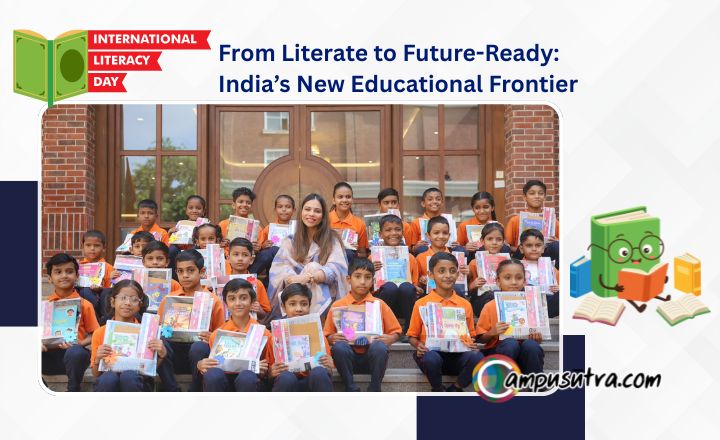
But with literacy rates improving, the focus is increasingly shifting from simply getting children into school to ensuring that education leads to meaningful opportunities. The philosophy is reflected in the work of Devyani Jaipuria, who has focused on education as part of her philanthropic work for more than two decades. Through Shiksha Kendra, her initiative supporting children from underserved communities, the focus has been on creating sustained access to education and helping students continue their learning journey. The initiative has reached more than 25,000 students over the years. Its impact can be seen in the journeys of students who have gone on to pursue higher education and secure opportunities with organisations including Deloitte, Amazon, SpiceJet, ICICI Bank, Tata Solar and Decathlon. One student is currently pursuing nursing studies in Georgia after receiving educational support through the initiative.
For Jaipuria, the emphasis is on building an institution that can continue creating opportunities for children over time rather than remaining limited to individual interventions. “Our intention was always to build something lasting, an institution rather than a programme. An institution keeps creating opportunity year after year, touching more lives than any single effort ever could,” said Devyani Jaipuria, Pro Vice Chairperson of DPS and Director on the Board of RJ Corp.
Beyond individual interventions, several organisations are also working to address India’s literacy challenge at scale. Central Square Foundation, for instance, works with governments across 11 states on foundational literacy and numeracy, supporting teacher training, learning resources and assessments. Its work has contributed to foundational learning programmes across thousands of schools.
At the community level, Food4Thought Foundation has taken a different approach by expanding access to books. The organisation has established 622 school and community libraries and reached more than 70,500 readers, demonstrating how access to reading material can become an important part of the literacy journey.
As India continues to make gains in literacy, the larger challenge is ensuring that those gains translate into better learning, continued education and greater opportunity. On International Literacy Day, the conversation is therefore moving beyond literacy as a number to education as a pathway to a more empowered future. Submitted by Sweta Singh