


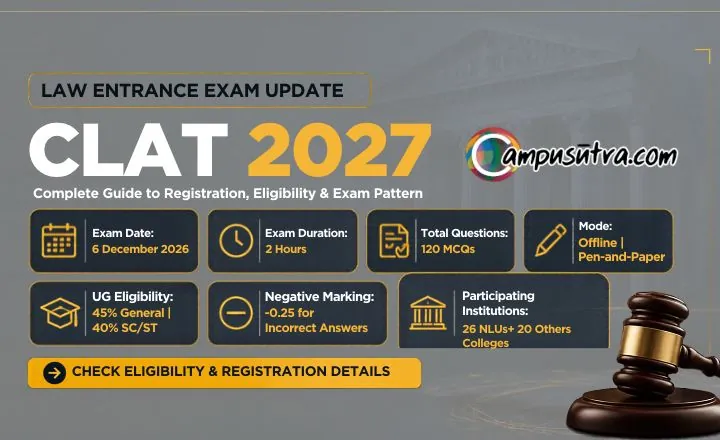
CLAT 2027: The Common Law Admission Test (CLAT) is India’s premier centralized national-level entrance examination administered by the Consortium of National Law Universities (NLUs). It serves as the single gateway for aspirants seeking admission to undergraduate (5-year integrated LL.B.) and postgraduate (1-year LL.M.) degree programmes across participating premier law schools in the country.
With the official application portal live on the Consortium of NLUs Official Portal, candidates aiming to secure seats in India’s elite legal institutions must understand the crucial timelines, structural changes, and eligibility norms.
Key Highlights & Overview: CLAT 2027
- Conducting Body: Consortium of National Law Universities
- Participating Institutions: 26 National Law Universities (NLUs) alongside affiliate universities and public sector undertakings (PSUs)
- Offered Programmes: 5-Year Integrated UG (BA/BSc/BBA LLB) & 1-Year PG (LL.M.)
- Mode of Examination: Offline (Pen-and-Paper based test)
CLAT Eligibility Criteria: UG & PG Programmes: As outlined in Campusutra’s CLAT Exam Overview, candidates must meet precise academic thresholds before applying:
- Undergraduate (UG) Programme — 5-Year Integrated LL.B.
- Educational Qualification: Candidates must have passed the Class 12 (10+2) or equivalent examination from a recognized board. Students appearing for their final board exams are also eligible to apply provisionally.
- Minimum Marks Requirement:
- General / OBC / PWD / NRI / PIO / OCI Categories: Minimum of 45% aggregate marks.
- SC / ST Categories: Minimum of 40% aggregate marks.
- Age Limit: There is no upper age limit prescribed for appearing in the UG CLAT exam.
- Postgraduate (PG) Programme — 1-Year LL.M.
- Educational Qualification: Must possess an LL.B. degree or an equivalent law qualification from a recognized university. Final-year LL.B. examinees are eligible to apply.
- Minimum Marks Requirement:
- General / OBC / PWD Categories: Minimum of 50% aggregate marks.
- SC / ST Categories: Minimum of 45% aggregate marks.
CLAT Exam Pattern & Marking Scheme: The offline examination is designed to test reading comprehension, analytical aptitude, and logical clarity rather than rote memorization:
- Duration: 2 Hours (120 Minutes)
- Total Questions: 120 Multiple Choice Questions (MCQs)
- Marking Scheme:
- +1 Mark for every correct response.
- -0.25 Marks negative marking for every incorrect answer.
Core Section Breakdown:
- English Language (20% weightage): Comprehension passages (approx. 450 words) testing vocabulary and grammar.
- Current Affairs & General Knowledge (25% weightage): Contemporary national/international events, arts, culture, and historical milestones.
- Quantitative Techniques (10% weightage): Class 10-level mathematical problems based on ratios, proportions, basic algebra, and data interpretation.
- Legal & Logical Reasoning: Evaluation of legal propositions, factual scenarios, critical thinking, and structured arguments.
Step-by-Step CLAT Application Process: To complete registration smoothly, follow these directions mapped out via Campusutra’s Admissions Portal Guidance:
- Navigate to the official portal hosted by the Consortium.
- Register using a valid mobile number and email ID, verifying through OTP.
- Fill out personal details, academic history, and choose up to three test center preferences.
- Upload clean scanned copies of your passport-sized photograph, signature, and necessary category certificates.
- Submit the non-refundable application fee online (₹4,000 for General/OBC/PWD and ₹3,500 for SC/ST/BPL categories).
For ongoing updates regarding admissions, cut-offs, and NLU seat matrices, bookmark Campusutra’s CLAT Section.


