


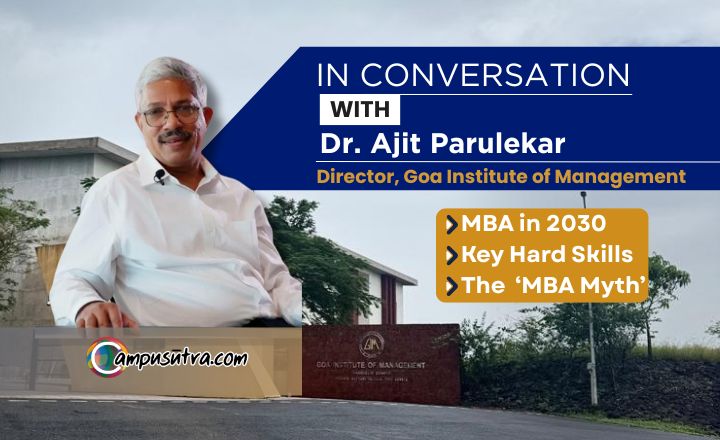
Campusutra : Greetings Dr. Parulekar. First of all, let me tell you the brand new infrastructure in GIM, looks more like a swanky corporate office. As a matter of fact, you are a hybrid professional … part corporate brand strategist, part academic and part active consultant, so…
- How does that initial “corporate DNA” influence your leadership as Director today, specifically regarding how GIM bridges the often-criticized gap between academic theory and day-to-day reality of corporate execution?
One of the biggest differences I’ve seen, drawing from my corporate experience, is the strong focus on execution, that is focusing on actually getting things done. In many purely academic settings, there tends to be a heavier emphasis on theory and analysis, which can sometimes lead to what is often referred to as “analysis paralysis.”
Breaking Barriers, Building Leaders: LIVE with Director, MDI Gurgaon
At GIM, the orientation is different. What we emphasize are three critical capabilities: understanding context, seeing the bigger picture, and developing the propensity to act. Problem-solving with an action mindset is integral to our programs and deeply embedded in our overall pedagogical approach.
This is reflected in the strong emphasis on experiential learning that goes well beyond the traditional case method. Students engage in hands-on, field-based experiences, work on live and virtual projects with companies, and learn through case studies rooted in real organizational challenges. We also run leadership in action programs such as immersive experiences in the Himalayas that closely simulate the realities and pressures of corporate life.
Equally important is our continuous engagement with the industry. Through our Board of Studies, regular industry speakers, visiting faculty, hackathons, and industry conclaves, we ensure that our curriculum remains relevant and that students are consistently exposed to real-world perspectives and expectations.
- As the editorial team of Campusutra.com, our goal is to extract insights that directly address the aspirations of our audience. And they would like to know about ROI, the value of niche specializations versus general MBAs, and what actually makes a candidate employable, sustain and excel in the corporate world – three key skills beyond grades, maybe ?
When we talk about ROI, I actually think it’s the wrong lens to use while making a choice, at least if ROI is defined narrowly. Looking at ROI only through the first job, first year, or first salary misses the larger picture. When someone invests ₹25–30 lakh in education, the objective is not just a placement outcome; it is a long-term career.
While the first job certainly matters, what is equally, if not more, important is where you end up 10 or 15 years down the line. To assess that, you need to look at the alumni of the institution. Where are they today? How many are CEOs or senior leaders across organizations? How many have built their own ventures, and at what scale? These outcomes provide a far more meaningful indicator of whether the ROI truly makes sense.
The second aspect is how students compare programs within an institution. At GIM, all four PGDM programs have identical fees and nearly identical placement outcomes. If you look at average, highest, or lowest salaries, the difference between the best-performing and lowest-performing program in any given year is less than five percent. Moreover, the “best-performing” program changes from year to year. So the choice of program at GIM is not about ROI. It is about what you are genuinely passionate about and the kind of career you want to build.
If one is deeply interested in analytics and the application of AI and technology, then the Big Data Analytics (BDA) program is the right fit for him/her and it has become increasingly AI-driven. If one’s interest lies in investment banking, financial markets, equities, fixed income, or treasury management, then BFSI makes sense. If one wants to be part of India’s healthcare transformation—one of the largest healthcare ecosystems globally, with significant government investment—then healthcare is the right choice.
Similarly, if one’s passion is brand management, strategic consulting, the IT sector, supply chain, or sustainability, that passion should guide one’s decision. The strength of GIM is that, regardless of the specialization, whether HR or any other domain, strong performers get strong outcomes. If one is good, one will earn well, and ROI will not be an issue. If one is not, then no specialization will magically fix that challenge.
- You’ve taught at IIMs, international schools, and lead GIM. You’ve seen higher education evolve for over two decades. If you could redesign the MBA curriculum from ?scratch today, what would be your top 3 non-negotiable subjects
If I were to redesign an MBA program and identify the top three subjects it should focus on, I don’t think they would be the traditional ones.
The first would be how to leverage technology for competitive advantage. Today, that naturally includes GenAI and other digital technologies. This is not about teaching technology in a generic way, but about applying it to what one is passionate about. For example, if one is interested in brand building, how does one use AI to strengthen brand strategy and engagement? If one’s focus is supply chains, how does one leverage AI, data analytics, blockchain, or distributed ledgers to create more integrated and efficient systems? Whether it is crypto applications or enterprise-level distributed ledgers, the emphasis should be on using technology meaningfully within specific business contexts. That would be a core pillar of any modern MBA.
The second critical area is understanding how people work, particularly in multigenerational environments. For the first time in history, organizations have five or even six generations working together (and this number is only likely to increase). These groups are highly talented, but they are also very different from one another. If leaders lack the skills to manage and leverage these differences, organizations risk becoming inefficient, conflicted, and unhappy places to work. The ability to lead across generations, build mentorship, and harness diverse strengths is therefore an essential capability for future managers.
The third area is thinking long-term through business models and narrative building. This involves understanding the broader context in which an organization, brand, product, or investment operates, and then learning how to construct a clear, concise, and compelling narrative. Many professionals struggle to articulate strategy, whether it is for investors, internal alignment, regulatory approvals, or government engagement. MBAs are increasingly expected to do this well: build narratives that are sharp, data-backed, and persuasive, and that clearly explain both the strategy and the rationale behind it.
- What’s the most unconventional career path you’ve seen a GIM graduate take that made you think ‘Wow, I never saw that coming’?
That’s a question to which I actually have many great answers, because the diversity of outcomes of our students is remarkable. Our alumni have gone on to pursue a wide range of careers, sometimes in very unconventional directions.
For instance, I have a former student who is now a successful wedding planner, and another who runs a chain of fast-food restaurants. Of course, many alumni follow more traditional paths of joining corporates and rising to senior leadership roles, including managing director and other CXO positions. But beyond that, the spectrum is incredibly broad. One alumnus serves as the legal head for McKinsey in the Benelux region, while another, who was originally a neurosurgeon, joined the program and now leads startups across the healthcare ecosystem.
Perhaps one of the most unconventional examples is a husband-and-wife alumni pair who now work with the Isha Foundation, focusing on ‘seva’ initiatives and finding deep fulfilment in social impact work.
We also have alumni from highly technical backgrounds. Structural engineers, hospitality professionals, architects, etc. have completed the program; today, one of the structural engineers leads a ₹53,000-crore real estate business in India. Another alumnus who started in marketing and brand management now heads one of the country’s leading advertising agencies. Yet another came from a small family-run electrical business and has since built it into one of the largest lighting solutions providers for public and private infrastructure projects in India.
These are just a few examples that come to mind immediately. What this reflects, I believe, is the environment we create—one that encourages students to explore their passions and equips them to succeed in a wide range of careers, rather than pushing them down a single, predefined path.
- Having held chairs for both Admissions and Placements in the past, you have seen the full life-cycle of a management student. What are the two crucial, non-academic traits you look for in an applicant during the admissions interview that you have seen almost invariably translates into high-value success during placements two years later?
When we look at admissions, there are two qualities I personally value most—and in my view, they are strong predictors of long-term success.
The first is achievement drive. How driven is the individual? How deeply passionate are they about what they want to pursue? More importantly, have they demonstrated this in the past by committing energy, effort, and perseverance to something they cared about, and by striving to master it? This sustained drive and willingness to work hard toward a goal is, I believe, the single most important factor that differentiates people who succeed over the long term.
The second quality is agility, particularly learning agility. This refers to an individual’s ability to adapt to change. When faced with a new environment or an unfamiliar domain, do they give up, telling themselves that it’s not their cup of tea or that they are not trained for it? Or are they able to learn quickly, recalibrate, and step confidently into a new paradigm? The ability to move across domains, pick up new skills rapidly, and thrive amid uncertainty is critical in today’s world. These qualities are not easy to find—but when we do find them, they are strong indicators of a sure-shot winner. And those are exactly the individuals we look to bring into GIM.
- You have been a consultant for diverse bodies like India Post, UNDP, and the Goa Government. When you look at the problems these major organizations face today, what are the critical “hard skills” they are desperately seeking in new hires that business schools are currently struggling to teach effectively?
The first and most critical capability is strategic thinking. I would break this into two parts, starting with analysis and critical thinking. How rigorous is a person’s thinking? Are they jumping to easy conclusions and relying on thumb rules, or are they willing to engage deeply with multiple sources of information?
Strong strategic thinkers go beyond surface-level analysis. They work with data, perform the necessary number-crunching, but do not make decisions based solely on numbers. Instead, they triangulate information, seeking insights from different sources, understanding contextual realities, and, wherever possible, gaining first-hand exposure to ground realities. This depth of thinking is something organizations increasingly look for, because they often find that weak or superficial strategic thinking is the reason many projects fail right from the start. This, in my view, is the number one hard skill.
The second capability companies are actively seeking today, far more than they did a few years ago, is a deep understanding of technology, particularly AI, within specific domains. This is not about generic familiarity with tools like ChatGPT or DALL-E. It is about understanding which AI tools exist, how processes work in a particular sector or function, and how technology can be meaningfully applied.
Whether the domain is sectoral or functional (such as the marketing value chain) the expectation is that professionals understand where and how AI can add value, improve efficiency, or rationalize costs at each stage. This kind of domain-specific technological understanding has become a critical differentiator in today’s business environment.
- Healthcare management wasn’t mainstream when GIM started the program under your leadership. For students currently debating between a general PGDM and a sector-specific program, what is your argument for specialization? What unique competencies does the healthcare sector demand right now that a generic MBA graduate simply doesn’t possess? How do you spot the ‘next big thing’ in education?
When we launched the Healthcare Management program in 2013, healthcare was neither fashionable nor considered an attractive career option in India. It simply did not receive the attention it deserved. However, we believed it was critical for the country. If you were to define the success of a nation and the well-being of its people, it ultimately comes down to three pillars – education, healthcare, and wealth.
At that point, education, particularly at leading institutions like GIM, was doing reasonably well. India’s economic story was also strengthening; we were emerging as one of the fastest-growing large economies in the world. Healthcare, however, stood out as an area that was underdeveloped and poorly organized in terms of delivery. That gap convinced us that this was a space where management education could make a meaningful impact.
Whether it was foresight or good fortune, within a few years of launching the program, the government introduced PMJAY (popularly known as Ayushman Bharat) bringing universal health coverage and significant public investment into the sector. This policy shift validated our early belief and reinforced the relevance of our pioneering work. More than a decade later, several IIMs are now entering this space, largely because GIM has established itself as a leader in healthcare management education.
In terms of career opportunities, the healthcare sector today looks dramatically different from what it did ten years ago. India is fast emerging as a global healthcare hub, particularly in addressing some of the world’s most pressing healthcare challenges. While healthcare costs are spiraling globally, India has managed to contain costs through innovation, especially in the domains of medical devices, service delivery, and operating models.
India is often referred to as the “pharmacy of the world,” and institutions like Aravind Eye Care demonstrate how high-quality healthcare can be delivered at a fraction of global costs. This transformation has been possible because professional management has entered a domain that was once dominated almost entirely by clinicians. The combination of clinical excellence and managerial capability has enabled the development of frugal yet high-quality healthcare models that are both financially and socially sustainable.
What truly differentiates GIM’s Healthcare Management program is its breadth and strategic depth. Unlike narrowly focused programs that concentrate only on pharmaceuticals, hospitals, or public health, we view healthcare as a large, diversified ecosystem. As a result, our graduates find opportunities across consulting firms including the Big Four, healthcare and life sciences verticals in technology and IoT firms, leading medical device companies such as Johnson & Johnson, Medtronic, and Conmed, pharmaceutical companies, hospital groups, health financing institutions, and many other segments of the healthcare value chain.
Despite being a sector-focused program, the compensation outcomes for our students are competitive with those of top MBA programs across the country. In fact, GIM is currently the only healthcare management program in India that consistently delivers salary outcomes at this level. Many other healthcare programs see lower compensation because they tend to prepare students for narrower, operational roles. In contrast, our approach is deliberately diversified and strategy-driven, enabling graduates to take on leadership roles across the healthcare ecosystem.
- We often come across a complex intersection of ethics, business, and policy when it comes to private health care institutes in India. How do you train students to balance the aggressive profit motives required by corporate healthcare with the ethical considerations inherent in the sector?
Ethical challenges in healthcare often arise not from a lack of values, but from poor management. Many of these issues emerge because decision-makers do not fully understand how the healthcare ecosystem functions. As a result, even clinicians and hospital leaders are often unclear about basic questions such as the financial performance or profitability of their own institutions. This typically happens because there is little or no application of management science. There are, unfortunately, no robust financial systems, no structured budgeting, and no strategic oversight.
While ethics and values are certainly important, focusing on them in isolation is not enough. What is equally critical is training people to understand that, at the core of any business (including healthcare) is customer/patient satisfaction. A satisfied customer is a profitable customer. This is not a new or speculative idea; it has been consistently demonstrated through research over the past 35–40 years, and repeated studies across decades have reinforced the same conclusion.
This principle applies just as strongly to healthcare organizations. The most profitable healthcare institutions tend to have high levels of patient satisfaction and relatively low instances of ethical lapses. That is why we emphasize building strong healthcare models that place the patient at the center. When patients are treated as valued customers who receive quality care, transparency, and trust, both ethical integrity and financial sustainability naturally follow.
- Given the rapid onset of generative AI and changing corporate expectations, the traditional two-year MBA model is often under scrutiny. What does the “MBA of 2030” look like in your vision, and what specific structural changes GIM is making today to ensure current students aren’t learning obsolete frameworks?
The MBA of 2030 will look very different from what we see today. It will involve fewer credits, significantly less time spent in traditional classrooms, far more collaborative learning, and much deeper integration of AI-assisted learning.
Let me explain what I mean by AI-assisted learning. We are currently the first business school in the country to use AI-driven case studies. Through curated case collections, such as those from INSEAD, students begin their case preparation by working one-on-one with an AI coach before coming to class. This interaction allows them to explore the problem, test assumptions, and develop an initial analysis independently. When they enter the classroom, the discussion is far richer as students bring informed perspectives, challenge one another, and collectively refine solutions in a highly engaging environment.
Beyond AI, we have also introduced AR–VR–based learning into the classroom. We have invested in two dedicated 65-seater labs equipped with immersive headsets (Pico 3 and Jio Tesseract). During selected sessions, students wear these headsets and step directly into the context of the case. If the case is set in a retail environment, they are virtually inside the store – not just watching a video, but also experiencing the space firsthand. If it’s a manufacturing case, they are placed inside a warehouse or production facility. This level of immersion brings experiential learning directly into the classroom in a way that was previously impossible.
Looking ahead, the emphasis will shift significantly from theory to applied learning. Faculty, students, AI tools, and structured workbooks will work together to create highly personalized learning experiences: not just in terms of content, but also in how students interact, learn, and progress.
In short, the MBA of 2030 will be leaner, more focused, technologically enabled, and deeply personalized. It will be designed to prepare students for a world that is evolving faster than ever before.
- What’s the biggest myth about MBA education that you’d like to bust for Campusutra.com readers?
The biggest myth about an MBA is the belief that once you get into a good business school, everything else falls into place. In the sense that you earn the degree, get a job, and life is set. That is simply not true. An MBA is not a finish line; it is the starting point. If you approach it as a credential that guarantees success, you are not preparing for the long haul.
An MBA is not about exams, concepts, or textbooks. It is about orientation. It is a way of thinking and acting that can only be developed by doing. That orientation cannot be picked up later, cannot be memorized from a book, and cannot be outsourced to tools like ChatGPT. AI can help you answer questions, score well, and even graduate, but it cannot build the skill set required for sustained impact. Without that foundation, you may get your first job, but you will struggle to grow beyond it.
By “long haul,” I mean becoming someone who truly matters – someone who creates impact, leads organizations, and shapes outcomes. That could be as a CEO in a corporate, a leader in government, or a change-maker in the social sector. That level of leadership demands far more than a degree.
Another important misconception is that an MBA is only about what happens in the classroom. In reality, it is equally about what you do alongside the program. If you feel technically underprepared, you must actively bridge that gap (through MOOCs, additional courses, reading widely, or using AI tools thoughtfully). The responsibility for learning does not stop with the curriculum.
Finally, and most importantly, an MBA is about context. It is not about formulas or theories in isolation. It is about understanding geopolitics, industry dynamics, competition, evolving consumer behaviour, and the role of technology in shaping how people live and work. This ability to connect multiple contexts is what makes an MBA one of the most holistic forms of education available—and it is something many aspirants underestimate.
That holistic orientation, more than the degree itself, is what determines whether an MBA truly delivers long-term value.
On behalf of the entire Campusutra.com editorial team, I extend our heartfelt thanks for this opportunity to engage with you in such a candid and enriching interview. Your openness in sharing perspectives on leadership, institutional vision, and the evolving landscape of management education has illuminated key issues for our readers but also highlighted the values and thought leadership that GIM embodies.
We deeply appreciate the time and thought you invested in the conversation. It is voices like yours that inspire students, educators, and industry stakeholders alike.


