



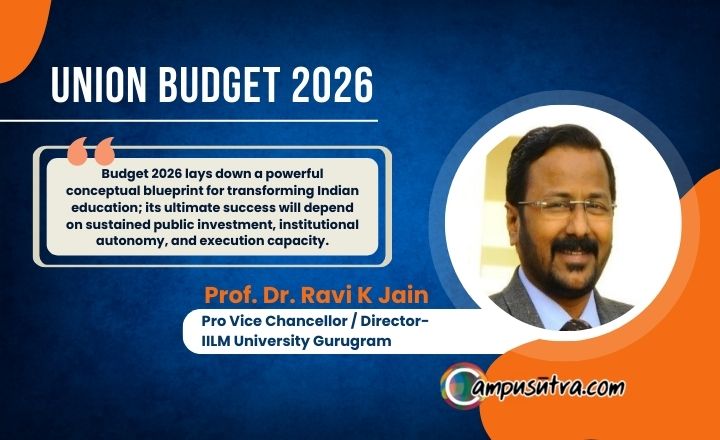
Union Budget 2026 marks a welcome shift in India’s education discourse—from access and expansion to capability, innovation, and global competitiveness. Around Rs. 1.39 lac crore consolidated allocation for education marginally higher than last year and is a little over 2.5% of the total budget outlay of Rs. 53.5 Lac crore. With allocations of ₹83562 crore for school education and ₹55,727 crore for higher education, the budget signals intent to modernise learning systems through artificial intelligence, skilling, and integrated academic infrastructure. Yet, the scale of ambition is still not fully matched by the depth of fiscal commitment.
The budget’s emphasis on AI-driven education, digital skilling, and emerging technology training has strong implications for women’s workforce participation, especially in STEM fields, where gender gaps remain acute. The key impact areas aimed at are, AI literacy, Digital design, Data analytics, Future skills, Bio-pharma, Tourism, IKS, Medical Tourism, Special training for thousands of guides, integration of heritage, hospitality etc. in education.
The decision to position artificial intelligence as foundational educational infrastructure is strategically significant.
The creation of a Centre of Excellence for AI in Education moves policy beyond digital delivery to intelligent pedagogy, adaptive assessment, and data-driven governance. If executed well, this could redefine classroom engagement, faculty productivity, and institutional effectiveness.
Similarly, the proposal to establish five university townships and academic zones offers a powerful model for building innovation-led knowledge cities, capable of anchoring regional development, industry collaboration, and startup ecosystems. This is a long-overdue structural reform that can reposition universities as engines of economic transformation.
The focus on girls’ hostels in every district reflects an acute understanding of grassroots barriers to female participation in education. By addressing safety and mobility constraints, the budget converts empowerment from intent to infrastructure, with potentially transformative social outcomes. This shall Moves girls’ education beyond social inclusion toward economic empowerment and leadership readiness.
However, three critical gaps persist
First, education spending remains below the 6% of GDP benchmark envisioned in the National Education Policy 2020, limiting systemic transformation. Second, the near absence of a national faculty development and academic leadership mission undermines the effectiveness of infrastructure-led reform. Technology cannot substitute for inspired teachers and capable academic leaders. Third, research funding lacks the depth required to propel India into the front ranks of global knowledge economies.
Budget 2026 provides a compelling strategic blueprint. Its success, however, will depend on sustained investment, institutional autonomy, and human capital development. The vision is right; the velocity must now be matched by scale.
Also read what Directors / Deans of other B Schools had to say.
-
What does the Union Budget 2026-2027 mean to Higher Education? ~ By Prof. (Dr.) V. Jayashree Director, VVISM Hyderabad
-
Union Budget 2026: Nirmala Sitharaman to Engage With Students Post-Budget Presentation
-
From Manpower Supplier to Skill Superpower: Why India Must Invest in Merit ~ Prof B C Patnaik Director NIA Pune
-
Union Budget 2026 – “Human capital at the centre of India’s growth story” – Dr. Debashis Chatterjee, Director, IIM Kozhikode
-
Budget 2026–27: Turning Education, Healthcare and Innovation into India’s Long-Term Growth Engine
-
Budget 2026–27 : Dr. Vinita Sahay, Dir, IIM Bodh Gaya – Highlights Youth Focus, Digital Ecosystem, and Affordability in Education
-
Expectations vs. Reality: What the Budget 2026 Means for Higher Education and the Common Citizen