


Like every year this year too we have been following the Union budget and have engaged with thought leaders from India’s premier management institutes to discuss the roadmap, execution, and student-centruc actionable. The Union Budget arrives at a time when the GD/PI also commences and the objective is also to run through possible pointers for the aspirants of MBA / PGDM to be prepared for any questions which they may face in the interviews. It has always helped students in the past as they can pick 2–3 points and build a structured answer in interviews, showing awareness of both opportunities and challenges.
While the Budget outlines ambitious goals around youth empowerment, skilling, and institutional partnerships, its framing as a roadmap to Viksit Bharat raises questions about execution and inclusivity. The emphasis on human capital, technology, and entrepreneurship is promising, yet some observers note that the measures risk being more aspirational than immediately actionable—particularly in Tier-2 and Tier-3 cities where structural challenges persist.
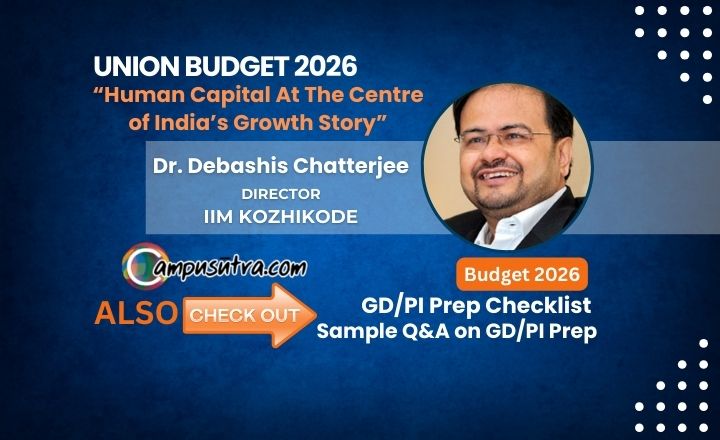
Against this backdrop, Dr. Prof. Debashis Chatterjee, Director of IIM Kozhikode, shared his perspective with Campusutra.com
Stating that the Budget is a vision document that seeks to balance scale, skill, and sustainability. His remarks highlight both the opportunities and the underlying need for careful implementation if India is to truly build a resilient and globally competitive economy, Dr. Debashis Chatterjee said, “The Union Budget 2026 should be read not merely as a fiscal statement, but as a forward-looking roadmap to Viksit Bharat. It places human capital at the centre of India’s growth story, with a clear emphasis on skill, scale, and sustainability—especially critical at a time when technology and AI are reshaping work and productivity. The focus on youth, skilling partnerships with premier institutions like the IIMs, infrastructure-led entrepreneurship, support for MSMEs, women-led enterprises, and sunrise sectors reflects a mature, human-centric economic vision. By strengthening capabilities across Tier-2 and Tier-3 cities and investing in creativity, innovation, and institutional capacity, the Budget takes a decisive step towards building a resilient, self-reliant, and globally competitive India.”
8 Big Changes in Education from Budget 2026
-
Education-to-Employment Committee
◦ A new high-level committee will connect education, jobs, and business.
◦ It will study how new technologies like AI affect skills and jobs, and suggest changes in courses.
-
New National Institute of Design (East India)
◦ A new design institute will be set up in eastern India.
◦ This will train more designers to meet the growing demand in industries like fashion, product design, and technology.
-
Five University Townships
◦ Five big “education cities” will be built near industrial corridors.
◦ These will have universities, colleges, research centers, and housing, making it easier for students to study and find jobs nearby.
-
Girls’ Hostels in Every District
◦ One girls’ hostel will be built in every district for students in STEM (science, technology, engineering, math).
◦ This will help women continue higher studies without worrying about accommodation.
-
New Telescope Facilities for Astronomy
◦ Four major telescope projects will be set up or upgraded.
◦ Students interested in space and astronomy will get better labs and research opportunities.
-
Regional Medical Hubs
◦ Five medical hubs will be created with hospitals, research centers, and training facilities.
◦ These will also support medical tourism and create jobs for doctors and healthcare students.
-
National Institute of Hospitality & Tourism Training
◦ The hotel management council will be upgraded into a National Institute of Hospitality.
◦ Plus, 10,000 tourist guides will be trained with a 12-week program at famous sites.
-
Lower Tax on Overseas Education Payments
◦ Families sending money abroad for education will pay less tax (2% instead of 5%).
◦ This reduces the financial burden for students studying overseas.
Union Budget 2026 – GD/PI Prep Checklist for Students
• Know the Big Themes: Youth empowerment, skilling, AI, MSMEs, women-led enterprises, sustainability.
• Education & Employment Link: Education-to-Employment Committee, university townships, girls’ hostels, design & innovation hubs.
• Sectoral Push: Healthcare hubs, tourism & hospitality training, semiconductor missions, astronomy research facilities.
• Fiscal Angle: Increased allocation for education, reduced tax on overseas education payments.
• Human Capital Focus: Skill, scale, sustainability as drivers of growth.
• Regional Development: Investments in Tier-2 and Tier-3 cities for inclusive growth.
• Entrepreneurship & MSMEs: Infrastructure-led support for startups and small businesses.
• Critical Viewpoint: Aspirational roadmap, but execution challenges remain—especially in smaller cities and institutions.
Sample Q&A 1 – Balanced Awareness
Question: “What is your view on the Union Budget 2026?”
Answer:
“The Union Budget 2026 places strong emphasis on youth empowerment and skill development. Initiatives like the Education-to-Employment Committee and university townships show intent to connect studies with jobs. However, the real challenge will be execution, especially in Tier-2 and Tier-3 cities. For students, it’s encouraging to see more focus on employability, but we must also be realistic about how quickly these changes will reach the ground.”
Sample Answer 2 – Student-Centric Focus
Question: “How does the Budget impact students?”
Answer:
“For students, the Budget is significant because it increases funding for education and introduces practical measures like girls’ hostels in every district and new design and innovation hubs. These steps make higher education more accessible and relevant. At the same time, the reduced tax on overseas education payments eases financial pressure for families. Overall, it signals that education is being seen as a direct pathway to employment.”
Sample Answer 3 – Critical but Constructive
Question: “Do you think the Budget delivers on its promises?”
Answer:
“The Budget sets ambitious goals—linking education with industry, boosting research in AI and astronomy, and supporting MSMEs. These are important directions. But the gap often lies in implementation. Unless institutions and local ecosystems are strengthened, students may not immediately benefit. Still, the intent to align skill, scale, and sustainability is a positive step toward preparing India’s youth for global competitiveness.”
Also read what Directors / Deans of other B Schools had to say.
-
Union Budget 2026: Nirmala Sitharaman to Engage With Students Post-Budget Presentation
-
From Manpower Supplier to Skill Superpower: Why India Must Invest in Merit ~ Prof B C Patnaik Director NIA Pune
-
Union Budget 2026 and Indian Education: Vision with Velocity, But Not Yet at Scale ~By Ravi Kumar Jain, Pro Vice Chancellor / Director, School of Management, IILM University, Gurugram.
-
Budget 2026–27: Turning Education, Healthcare and Innovation into India’s Long-Term Growth Engine
-
Budget 2026–27 : Dr. Vinita Sahay, Dir, IIM Bodh Gaya – Highlights Youth Focus, Digital Ecosystem, and Affordability in Education
-
Expectations vs. Reality: What the Budget 2026 Means for Higher Education and the Common Citizen
-
What does the Union Budget 2026-2027 mean to Higher Education?