



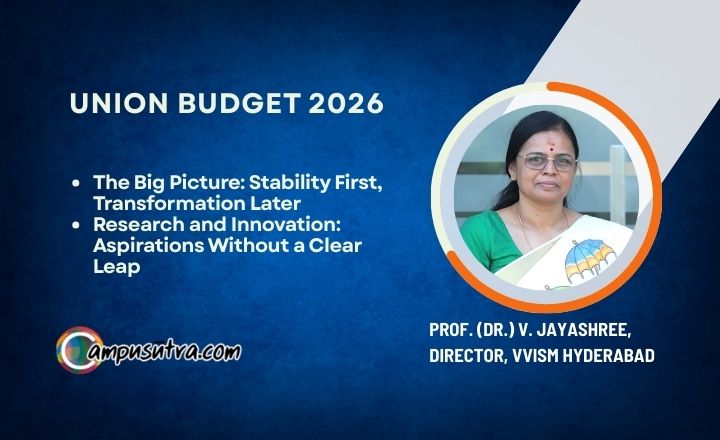
I listened to the Union Budget 2026–27 speech carefully. Not just for numbers, but for signals. As educators, we’ve learnt that often what is left unsaid is more important that what is said.
The Budget speech of Finance Minister Mrs. Nirmala Sitharaman spoke of stability, inclusion, productivity, and India’s long-term growth path. There was a clear emphasis on skilling, digital public infrastructure, and technology-led development. From a macroeconomic standpoint, the tone was reassuring.
The Big Picture: Stability First, Transformation Later
The Budget speech reinforced India’s strong growth momentum and fiscal discipline. Education featured within the broader framework of human capital development, skilling, and inclusive growth rather than as a standalone transformation agenda. That framing is important.It tells us that higher education is being viewed as an enabler of economic growth, not yet as a strategic engine in its own right. For institutions on the ground, this distinction matters.
Employability and Skilling: Strong Intent, Limited Integration
One of the strongest threads in the speech was skilling and workforce readiness. There was repeated emphasis on youth employability, industry needs, and productivity enhancement.The disconnect between degrees and employability is real, and it’s something institutions struggle with constantly.
However, what the speech doesn’t fully address is where this skilling will happen and how deeply it will integrate with higher education.
Skilling continues to sit slightly outside the academic core—through missions, schemes, and parallel frameworks. What many of us were hoping to see was a clearer push to embed employability within degree programs
themselves. Degrees and skills can’t keep running on parallel tracks. They have to converge.
Digital Infrastructure and AI: Ambition Is Clear, Readiness Is Uneven
The speech leaned heavily into technology—AI, digital platforms, and next-generation infrastructure. India’s digital public architecture was rightly positioned as a national strength.
But here’s where we educators see the gap. Digital access is improving rapidly. Digital academic readiness is not. AI in education isn’t just about tools. It requires trained faculty, redesigned curricula, access to computing resources, and time for experimentation. Most Tier-2 and Tier-3 institutions are still grappling with basic digital consolidation.
The speech inspires confidence in India’s tech trajectory. What it doesn’t address is how evenly that trajectory will play out across institutions. Without targeted academic support, AI risks becoming an advantage for a few, rather than an equaliser for many.
Research and Innovation: Aspirations Without a Clear Leap
Innovation and research found mention in the broader growth narrative, but higher education-led research did not emerge as a central pillar in the speech. For years now, educators have been hoping for a decisive shift—from project-based funding to ecosystem-based research support. From fragmented grants to long-term institutional capacity building.
I understand that we are in a fiscally cautious environment. But with no clarity on the emphasis on research support, Indian universities will remain largely teaching-focussed while global peers steadily strengthen their research depth.If we want our institutions to feature in global knowledge networks, research cannot remain peripheral.
Cost of Education and Institutional Sustainability: The Quiet Challenge
The speech spoke about inclusion and access, which is welcome. But it did not address the growing financial pressures faced by institutions themselves—especially self-financed ones. Rising technology costs, faculty retention challenges, compliance requirements, expectations of global standards etc. These pressures are real, and they directly impact quality.
Affordability for students cannot be achieved by silently stretching institutions thinner each year. Sustainable quality requires a candid conversation on institutional economics which we are yet to be discussed.
Professors of Practice: Mentioned in Spirit, Not Yet in Structure
The Budget speech spoke about industry participation, applied learning, and workforce relevance. These ideas align perfectly with the concept of Professors of Practice. But alignment in spirit isn’t the same as institutional backing. There was no clear articulation of how industry professionals will be systematically integrated into campuses, especially beyond elite institutions. No mention of funding support, long-term engagement models, or incentives for sustained participation.
From my perspective, this remains a missed opportunity. If we truly want students to learn from practice—not just theory—then practitioners must become a stable part of academic ecosystems, not occasional visitors.
The 6% of GDP Question: Still a Reference Point, Not a Roadmap
Education spending continues to improve incrementally, but the long-standing aspiration of 6% of GDP remains just that—an aspiration. What many of us were hoping to hear was not a sudden leap, but a clear direction of travel. A timeline. A sense of commitment beyond continuity. The speech chose caution over bold signalling.
Women and Higher Education
There was an announcement of establishing a girls’ hostel in every district across India to boost women participation in higher education. This plan supported by a Rs. 10,000 crore investment aims to provide safe accessible accommodation to nearby colleges. It is a broad push to enhance women’s safety and empowerment through infrastructure development. It aligns with the government’s focus on “nari shakthi”. My personal opinion on this is that this initiative could be taken up on a PPP model so that it is not just the government, but the corporate world will also be able to contribute to this initiative.
So, What Does This Budget Mean for Higher Education?
This budget is a steady and responsible one. It is reassuring. It is trying to align higher education with growth, but not yet completely. This is my honest takeaway. India has built scale and now should concentrate on building depth. We have expanded access, now we have to invest in excellence. We have to work towards embedding employability in a structural manner. Higher education cannot remain a supporting act in India’s growth story. It must become one of its leading drivers.
That shift may not happen on one budget. But it will require, sooner rather than later, a budget that places universities, faculty, and research at the very centre of India’s future narrative.
Also read what Directors / Deans of other B Schools had to say.
-
Union Budget 2026: Nirmala Sitharaman to Engage With Students Post-Budget Presentation
-
From Manpower Supplier to Skill Superpower: Why India Must Invest in Merit ~ Prof B C Patnaik Director NIA Pune
-
Union Budget 2026 – “Human capital at the centre of India’s growth story” – Dr. Debashis Chatterjee, Director, IIM Kozhikode
-
Union Budget 2026 and Indian Education: Vision with Velocity, But Not Yet at Scale ~By Ravi Kumar Jain, Pro Vice Chancellor / Director, School of Management, IILM University, Gurugram.
-
Budget 2026–27: Turning Education, Healthcare and Innovation into India’s Long-Term Growth Engine
-
Budget 2026–27 : Dr. Vinita Sahay, Dir, IIM Bodh Gaya – Highlights Youth Focus, Digital Ecosystem, and Affordability in Education
-
Expectations vs. Reality: What the Budget 2026 Means for Higher Education and the Common Citizen