


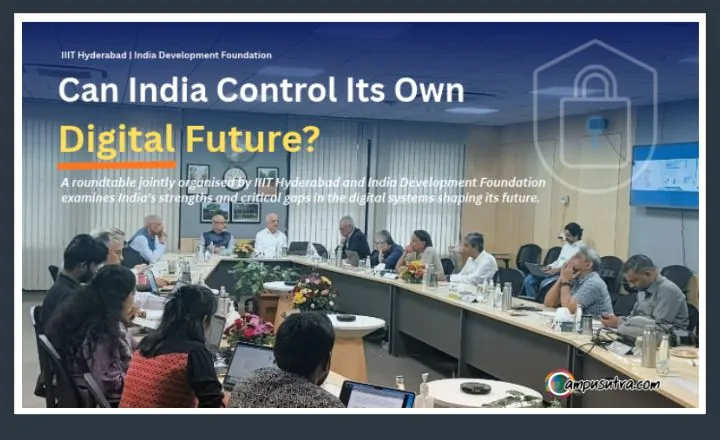
As technology becomes the backbone of modern governance, economic growth, and national security, India stands at a critical crossroads. While the nation has earned global acclaim for building population-scale Digital Public Infrastructure (DPI) like Aadhaar, UPI, DigiLocker, and ONDC, a pressing question remains: How much control does India truly have over the digital systems it relies upon?
This dilemma formed the core of a recent high-level roundtable titled Towards Digital Sovereignty: India’s Capabilities, Gaps and Resource Requirements, jointly hosted by IIIT Hyderabad and the India Development Foundation (IDF). Bringing together prominent voices from policymaking, academia, and the tech industry including former MeitY Secretary R. Chandrashekhar, IIIT-H Director Prof. Sandeep Kumar Shukla, IDF Founder Prof. Shubhashis Gangopadhyay, and NPCI MD & CEO Dilip Asbe, the forum dissected what digital sovereignty means for an emerging superpower in an interconnected world.
Sovereignty Is the Power to Choose, Not Isolation
A key consensus from the roundtable was that digital sovereignty should not be mistaken for total technological isolation. Attempting to build every component domestically from advanced semiconductors and operating systems to cloud infrastructure is neither practical nor economically viable. Instead, experts framed sovereignty on a spectrum: moving away from excessive external dependence toward managed dependence, strategic partnerships, and targeted domestic capability.
True digital sovereignty, as noted during the discussions, is the power to choose, control, and govern critical technologies. It is about building strategic leverage in global value chains much like ASML’s dominance in lithography or China’s hold over rare earths so that India can negotiate from a position of strength even while collaborating globally.
The Status Quo: High Talent, Low Ownership
Despite having a massive domestic market, a thriving startup ecosystem, and a deep pool of engineering talent, India faces structural vulnerabilities:
- Infrastructure Dependence: The country still relies heavily on foreign providers for foundational hardware, cloud networks, and major digital platforms. Recent geopolitical flashpoints such as chip export restrictions, the withdrawal of cloud services in sanctioned regions, and data access concerns under foreign laws like the US CLOUD Act underscore the risks of external reliance.
- The Data and Ownership Paradox: Generating vast amounts of data domestically does not guarantee Indian ownership. Much of India’s raw data is processed abroad and sold back as finished products, while rich local datasets (such as in agriculture) remain underutilized. Furthermore, a significant portion of the cutting-edge tech developed in India by Indian engineers is legally owned by foreign corporations.
- The Research-to-Market Gap: While Indian academic institutions produce substantial research, very little translates into commercial, widely adopted products. A preference for short-term returns in the private sector, coupled with a lack of patient capital and sluggish public procurement, often stifles long-term deep-tech innovation.
A Strategic Blueprint for the Future
To bridge these gaps, the roundtable outlined a pragmatic roadmap focused on targeted investments rather than spreading resources thin:
- Prioritizing Foundational Tech: India must build immediate, self-reliant capabilities in critical sectors like defense, cybersecurity, and policing, while investing heavily in Artificial Intelligence, Quantum Technologies, and Robotics.
- Domain-Specific AI Over Generic Models: Rather than competing solely in the capital-intensive race to build massive general-purpose LLMs, India should leverage its unique datasets to build hundreds of domain-specific Small Language Models (SLMs) in healthcare, agriculture, and education. A prime example highlighted at the event was AIG Hospitals, which utilized 30 years of internal medical records to develop an AI model capable of predicting cardiac emergencies up to two hours in advance.
- Exporting Protocol-Based DPI: Drawing from the multi-stakeholder success of UPI which required synergy between the RBI, banks, fintechs, and governance frameworks India should continue exporting open, protocol-based digital infrastructure, particularly across the Global South, while actively shaping global tech standards.
- Ensuring Digital Inclusivity: Sovereignty is incomplete if it leaves citizens behind. With roughly 30–35% of the population still at risk of digital exclusion, building accessible technologies alongside reliable physical alternatives remains an urgent priority.
Moving From Ambition to Action
For India’s academic institutions, researchers, and emerging tech talent, the takeaway is clear: the next phase of India’s digital revolution requires moving beyond service delivery to foundational ownership. By selecting three to five strategic sectors for large-scale pilot projects and aligning academic research, patient capital, and agile regulation India can transition from being a consumer of global technology to an architect of its own digital destiny. Source : https://blogs.iiit.ac.in/digital-sovereignty-roundtable/


