


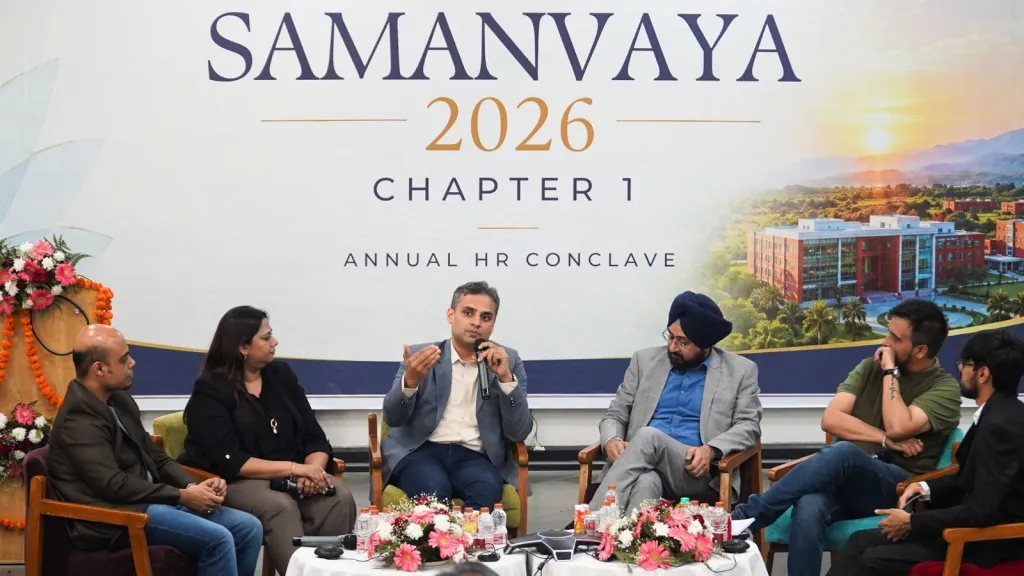
The stable 9-to-5 job, the linear career path and loyalty measured in years served may look very different by 2040. As artificial intelligence (AI) enters more workplace processes, companies are rethinking how they hire, assess and retain people. All this, while younger professionals are putting more weight on flexibility, meaningful work and the chance to contribute.
Apply to any top 250 B Schools from one window. Shortlist, save. CLICK
These shifts were the focus of Samanvaya 2026, the HR conclave at the Indian Institute of Management Kashipur (IIM Kashipur) . The central question was whether AI will shrink opportunities for young professionals or simply change what is expected of them.
HR leaders on the panel leaned towards the second view: AI is more likely to change how jobs are done than to remove the need for people, and as routine work is automated, judgement and problem-solving count for more.
The Human Advantage in an AI Age: Leaders Speak at IIM Sambalpur Conclave
A recent IIT Madras white paper makes a similar case. It argues that AI being able to perform a task does not mean an entire job or profession will disappear, and it proposes looking at impact on four levels: tasks, jobs, occupations and the wider labour market. Most jobs bundle many tasks, and only some can be handed to a machine.
Outcomes depend on the nature of the work, the technology’s capabilities, deployment costs, regulatory safeguards and how organisations restructure.
The paper also notes that junior work, though repetitive and individually low in value, collectively teaches the judgement people later need in senior roles. If AI absorbs those tasks, the apprenticeship that built experienced professionals could thin out, which is why the paper says companies may need to rethink how they train junior staff.
This is also why panellists said AI is raising the bar for freshers, who now need real depth in their field and not just familiarity with tools.
IIM Ahmedabad announces admissions to its two-year Blended MBA Programme in Business Analytics & AI
Workplace structures are shifting along with this. Junior employees are being drawn into more important decisions, and loyalty is increasingly judged by the quality of someone’s contribution, not the length of their tenure. Younger employees want work matched to their interests and measured by outcomes instead of hours at a desk. For organisations, the challenge is balancing that flexibility with accountability, and equipping managers to lead people whose expectations of autonomy and progression differ from earlier generations’.
What will make a candidate employable in 2040?
If degrees and job titles carry less weight, what will set candidates apart? A second panel, ‘Beyond the Checkbox: What Will Strengthen the Resume by 2040?’, looked at hiring moving beyond certifications and conventional screening.
The problem is partly AI itself. When recruiters and applicants both use AI tools, a polished resume proves little. Recruiters said they now probe the reasoning behind a candidate’s achievements, looking for business understanding, adaptability and the ability to explain how their work made a difference.
Skills that cannot be demonstrated in an interview are better left off the page. Hands-on exposure, through internships and real projects, is what helps freshers stand out, and it also answers the apprenticeship gap the IIT Madras paper describes.
MDI Gurgaon PGDM Admission 2027–29 Applications Now Open
Qualities that credentials capture poorly, such as empathy, emotional intelligence, discipline and the ability to work across organisational cultures, are likely to keep their value. Some companies are also using reverse mentoring, where younger employees share their perspectives with senior managers, to keep pace with changing expectations.
But with the advent of AI, for students entering the workforce, adaptability may matter as much as technical qualifications. By 2040, a strong career may depend less on fitting a predefined job description and more on how well someone can learn, solve problems and contribute as work keeps changing. Source: The Indian Express.


