


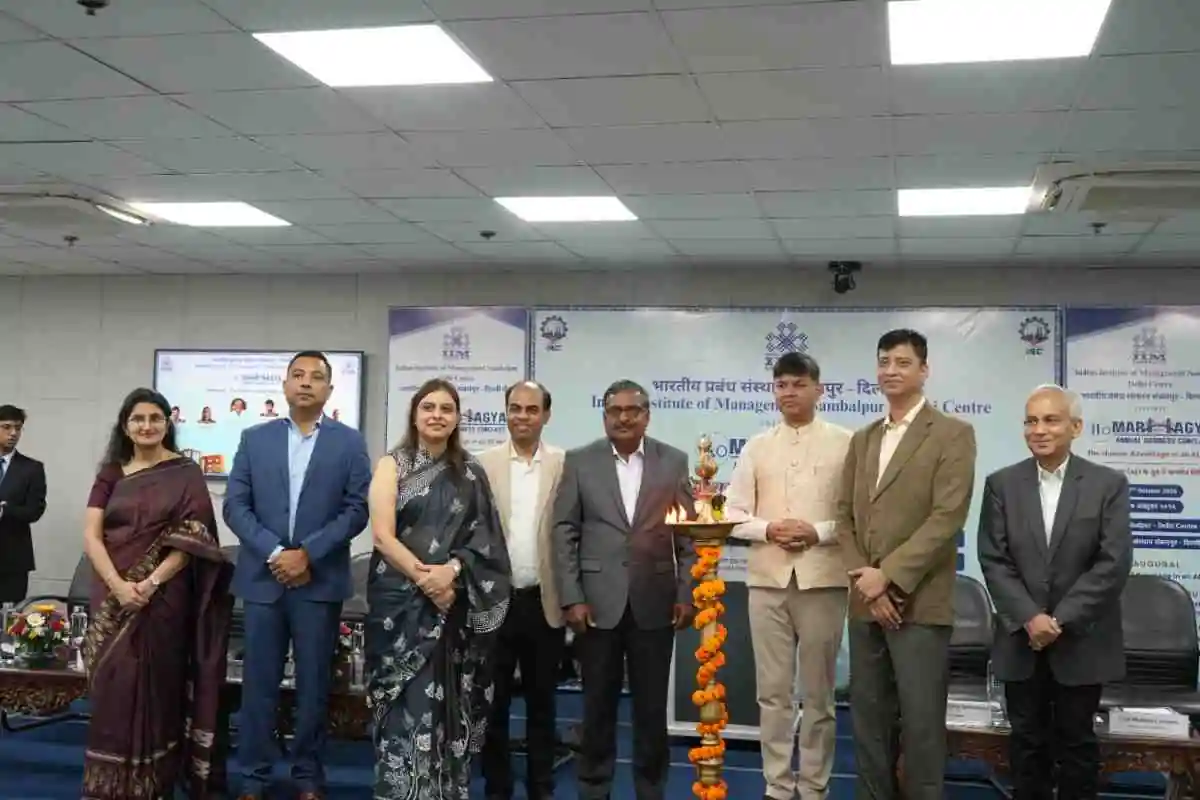
New Delhi, 18 Oct, 2026: When every company can buy the same AI tools, the advantage shifts back to people. That was the common thread at Marmagya 11.0, the annual business conclave of the Indian Institute of Management Sambalpur, held on Saturday at the IIM Sambalpur Delhi Centre on the ISID Campus, Vasant Kunj.
The Delhi edition, on the theme “The Human Advantage in an AI Age”, brought together business leaders, policymakers, faculty and students to discuss what will set Indian enterprises apart in the coming decade, once intelligence, speed and scale are available to every competitor. The programme was presided by Prof Mahadeo Jaiswal, Founding Director, IIM and coordinated by Prof. Chhavi Gupta, Chairperson, Marmagya 11.0, IIM Sambalpur – Delhi Centre.
Apply to any top 250 B Schools from one window. Shortlist, save. CLICK
▶️ REGISTER HERE For More MBA Updates.
The conclave follows the Sambalpur edition of  Marmagya 11.0, held on 3 and 4 October alongside the institute’s 12th Foundation Day.
Opening the conclave, Prof Jaiswal said AI would shape the economy, governance and education for years to come, and that India’s edge would come from the human side of the technology. He described three uses of AI: cognitive automation, cognitive assessment, and cognitive engagement with students and customers. He urged industry to look beyond automation to the other two, where the most impactful and innovative uses lie.
“There is a lot of discussion worldwide about whether AI is going to disrupt existing industry, business and governance. It is definitely going to disrupt, but it is not going to destroy. It is going to enhance. In education, rote learning will go out, because information and knowledge are now easily available through AI. What AI cannot do is create ideas, and that is what the classroom will be about. India has one of the largest young populations in the world, and the next ten years can be a game changer for the country if we take advantage of the human side of AI. When government, institutions and industry work together, our students, faculty and industry partners can co-create that human side, and it can become a model for the rest of the world,” Prof Jaiswal said.
IIM Ahmedabad announces admissions to its two-year Blended MBA Programme in Business Analytics & AI
The Chief Guest, Ambassador Raj Kumar Srivastava, Dean of the Sushma Swaraj Institute of Foreign Service, tied the conclave’s theme to the meaning of its name: having the knowledge and wisdom to know the essence of things. He said India’s comfort with diversity is one reason Indian leaders now head many of the world’s multinational corporations. Drawing on India’s ancient texts, he gave future leaders five principles: truthfulness, non-harm, service, equanimity and swadharma, finding one’s own purpose.
“AI is taking away much of the mundane work from humanity and making our lives more creative. But every future leader must first answer one question: what is the purpose of your life? If you answer it correctly, AI will become a tool in your hands. If you don’t, AI will overpower you. In the world of AI, lies will be easily deciphered, so be truthful. Equanimity is the biggest strength in the age of AI. Leadership begins with the self. Once you understand your own body and mind, AI will become your servant. If you don’t, AI will become your master,” said Ambassador Srivastava.
DoMS IIT Madras Final Placement Report 2026 Batch
Inaugural session: Guests of Honour
The inaugural session, “The Human Advantage in an AI Age”, also heard from the Guests of Honour, who looked at what sets people apart when AI tools are available to everyone.
Kushnava Laha, Head of Services Strategy, Cloud Software and Services, Ericsson, said AI has not removed the hard part of work but moved it higher. Machines now do the repetitive tasks, and people are left to make high-stakes decisions quickly on information that AI produces. He said professionals need to frame problems clearly, check what AI produces, understand its guardrails and biases, and take responsibility for the outcome.
MDI Gurgaon PGDM Admission 2027–29 Applications Now Open
“The cognitive load has shifted from the mundane, repetitive work to higher decisions that we have to take within a very short time, based on the information AI gives us. So the skills are pivoting. Two people can ask the same question in two different ways and get completely different answers, so defining the intent and the business problem matters. You need the capability to validate what AI gives you, because one small mistake, if allowed to percolate, can land somewhere you never expected. And you have to own the outcome. If a calculator makes a mistake in your answer script, the teacher still deducts marks. You cannot tell your company that AI did it. Don’t be scared that AI will take away jobs. The bigger risk is for experienced professionals who have not pivoted. And the most important skill of all is the skill to learn new skills, because today it is AI, and tomorrow we don’t know what technology will come,” said Mr Laha.
Dimple Kaloya, HR Leader, told students that every professional now needs T-shaped skills: depth in their own subject, and breadth across leadership, technology and brand. She said human judgment, curiosity, empathy and innovation would decide how far AI takes organisations.
 “In the age of AI, every professional needs T-shaped skills: real depth in their own subject, whether that is sales, HR or finance, and breadth across leadership, technology and brand. When ChatGPT gives you a response, the skill the world needs is the judgment to decide whether it makes sense for you and your business. You will not get there with one prompt. You have to work through it, challenge it and iterate, using AI as your thought partner. AI is a friend, not a threat. Human judgment, curiosity, empathy and innovation are what will carry the momentum of AI to the next frontier, and with 10 million graduates every year, the world is looking to India’s talent to drive it,” said Ms Kaloya.
Amit Gupta, Practice Head, Global AI Consulting Group, Mastercard, said the debate on AI and jobs in India often overlooks the majority of the country. He cautioned that buying AI tools is not the same as getting results from them.
“At our headquarters in New York last month, the first question about India and AI was whether the country would lose millions of jobs. But AI in India today is used mostly in urban India, perhaps 25 to 30 per cent of the country. Seventy per cent of India is rural, and the real question is how AI reaches that seventy per cent and makes a difference to their lives. Even in boardrooms, companies have bought the licences, yet the honest answer is that emails look better and business is as usual. Clients are sceptical and price AI-generated work differently. So embrace these tools, but verifying what you produce is on your shoulders. Human judgment is always the super layer,” said Mr Gupta.
IIM Kozhikode and Accenture LearnVantage Join Hands to Launch Global MBA Programme
Leadership Dialogues:
The first leadership dialogue looked at how organisations can stay effective when technology and employee expectations change together and no stable blueprint exists. The panel discussed redesigning work, reskilling at scale, and building cultures that keep the workforce’s trust. Akshay Rakshit, Head, Talent Acquisition & Strategy, Hyundai, moderated. The panellists were Vikram Lalla, General Manager & Head – Global Compensation, ITC Infotech; Prabhat Mani Pandey, Vice President – Corporate HR & IR, Varun Beverages; Shailesh Goyal, CHRO, Innovatiview; Nitin Mishra, Head, Talent Acquisition, India, Cushman & Wakefield; and Shirish Shete, Vice President – Corporate HRBP & Head, L&D, Bajaj Life Insurance.
Setting up the discussion, Mr Rakshit said: “Every technology wave since the 1990s has disrupted work, but it has also created potential. Technology creates potential, potential leads to productivity, and it is leaders and people who turn that productivity into business outcomes. The real question for organisations is how to redesign work, talent, leadership and rewards without losing the human capabilities that sustain them. In this AI world, questions are more important than answers. A contract that once took ten days with the legal team, I can now draft as a baseline myself with AI. But that does not make me the company secretary or the legal head.”
Panellists agreed that trust has to come first. Mr Pandey recalled his time as plant HR head at Union Carbide, when the company brought in robotic machines for the first time. A machine
IIM Amritsar Hosts Pariprekshya’26, the 10th Annual Finance & Marketing Conclave
run by 22 operators and engineers was replaced by one that needed only four people. The union had not been consulted before the machine was commissioned, and it stood idle for nearly two months. It came back into use only after one-to-one counselling with union leaders, operators and engineers, and a programme to reskill the workforce. No jobs had in fact been planned to go. The rollout went on to become a model for the company’s other locations.
Mr Mishra said employees are rarely afraid of the technology itself. What worries them is the uncertainty around it, and organisations have to address that openly and give people back their confidence. Mr Lalla said AI adoption is the reskilling priority for every function, which means breaking jobs down to see where AI fits best while staying within ethical limits. Mr Shete described AI tools that help Bajaj Life Insurance’s frontline sales teams serve customers who now arrive having done their own research. Mr Goyal said leadership must first establish that AI is here to stay, so that awareness of the need for change can shift beliefs and behaviours.
Much of India’s next decade of growth depends on technology reaching customers, enterprises and markets it has never served. The second leadership dialogue looked at how trust can be earned and risk managed at that scale. It covered how businesses build trust in underserved markets, how data and AI are reshaping risk assessment, and how leaders place bets when the opportunity is vast but the terrain is unproven. The panel included Shipra Wadhawan, Director, Technology, OSTTRA; Amit Gupta, Business Head, Tata Nexarc; Golok Kumar Simli, President, Technology & Innovation, BLS International; Ritu Arora, VP, Engineering, Capgemini; Kaushik Konlade, Director, Talent Acquisition & Finance, Pattern; and Himanshu Solanki, Marketing Head, IOL, Johnson & Johnson.
About Marmagya: Marmagya is the annual business conclave of IIM Sambalpur. Built on the values of Innovation, Integrity and Inclusiveness, it brings together CXOs, policymakers, entrepreneurs, academicians and students to discuss the ideas and challenges shaping Indian and global business. Now in its eleventh edition, it is held at the institute’s Sambalpur campus and its Delhi Centre.
Submitted by Swetajali Kar, Public Relations Manager, IIM Sambalpur.
Disclaimer: Team Campusutra did not create or edit this Content


