



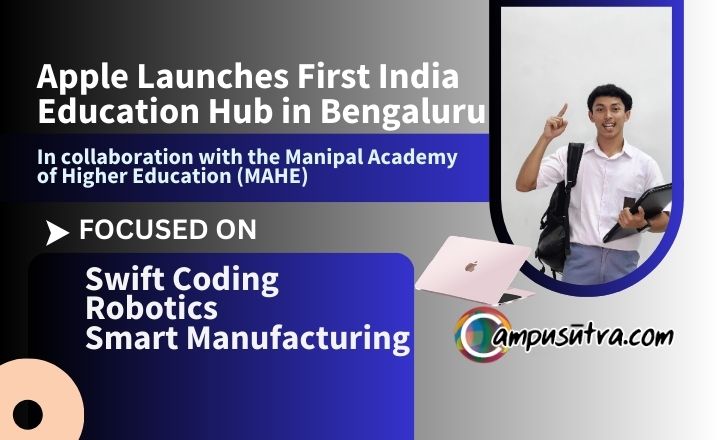
Bengaluru, February 4, 2026 – In a significant move to bridge the gap between classroom learning and industrial application, tech giant Apple has announced the launch of its first-ever Education Hub in India. Located in the tech capital of Bengaluru, this initiative is set to redefine workforce development by offering advanced training in coding, automation, and digital skills.
Operated in collaboration with the Manipal Academy of Higher Education (MAHE), the hub aims to empower thousands of individuals within Apple’s supply chain, preparing them for the next generation of high-tech manufacturing.
A New Era of Technical Training in India
The Bengaluru hub marks Apple’s fourth such facility globally—joining the ranks of similar centers in the US, China, and Vietnam. The primary focus is to equip the Indian workforce with “future-ready” skills through a curriculum that includes:
-
Swift Programming: Introductory and advanced coding using Apple’s powerful Swift language.
-
Robotics & Automation: Hands-on training in managing automated assembly lines.
-
Smart Manufacturing: Learning the integration of AI and data in production processes.
-
Digital Literacy: Foundational skills for the modern digital economy.
The “Train-the-Trainer” Model
A standout feature of this collaboration is the train-the-trainer model. Specialized faculty from MAHE will first train instructors from various supplier companies. These instructors will then return to their respective manufacturing sites to deliver the coursework to larger employee groups.
“This collaboration brings together Apple’s commitment to its supplier employees and Manipal’s experience in applied education to create meaningful opportunities for growth,” said Lt. Gen. (Dr.) M.D. Venkatesh, Vice Chancellor at MAHE.
Scaling Across the Supply Chain: Focus on Tata Electronics
While the Bengaluru hub serves as the central node, the program is scaling rapidly. Apple is expanding its suite of development courses to more than 25 supplier locations across India. Tata Electronics, a key player in India’s iPhone manufacturing ecosystem, will be among the first to adopt this updated curriculum.
Supporting Inclusive Growth
The initiative is backed by Apple’s global $50 million Supplier Employee Development Fund. Beyond technical skills, the program emphasizes inclusivity:
-
Vocational Training for Persons with Disabilities: Through partnerships with Salcomp and the NGO Enable India, Apple is enhancing career paths for differently-abled employees.
-
Rights & Health Awareness: The curriculum includes over 75 courses covering worker rights, health education, and professional development.
Editor’s Note – A Step Towards Bridging the Industry-ready Gap
For the community at Campusutra, this news highlights the shifting landscape of Indian manufacturing. India is no longer just an assembly outpost; with Apple’s investment in robotics and coding at the factory level, the country is moving up the value chain toward complex, high-skill manufacturing.
This initiative aligns perfectly with the “Make in India” vision, ensuring that as global giants expand their footprint, the Indian workforce evolves from manual labor to tech-driven roles.
For years, the “industry-ready” gap has been the elephant in the room for Indian engineering and vocational education. While a degree gets you a seat at the table, Apple’s move to bring its Supplier Employee Development Fund to Bengaluru suggests that “seats” are being replaced by “specialized stations.”
This isn’t just a corporate training module; it’s a signal to the Indian education ecosystem. When a global giant like Apple chooses to embed Swift coding and robotics directly into the supply chain, it essentially sets a new benchmark for what “vocational training” should look like. For students, the message is clear: the line between “blue-collar” manufacturing and “white-collar” software development is blurring. The factory worker of 2026 is becoming a tech-specialist.
Partnerships like this with MAHE are no longer “optional extras”; they are blueprints for survival in a tech-driven economy.