


Editorial, Campusutra : Every year, as the Common Admission Test (CAT) registration timeline approaches its peak, whispers of candidate anxiety and industry skepticism begin to circulate. Interim application counts trigger premature debates on whether management education is losing its charm.
Apply to any top 250 B Schools from one window. Shortlist, save. CLICK
▶️ REGISTER HERE For More MBA Updates.
However, official trends and long-term data straight from the top Indian Management Institutes (IIMs and Non-IIMs) reveal a very different reality: management education isn’t fading – it is evolving into an essential, non-negotiable strategic asset for young professionals.
▶️ Join our MBA 2027 HelpLine WhatsApp Group
1. The Numbers Behind the Noise: Contextualizing Registration Dynamics
It is easy to misinterpret interim application numbers. While commentary often reacts to early estimates mid-way through the application window, official IIM data shows that the final days before the registration deadline consistently see a massive surge of candidate filings.
- The 300,000 Benchmark: In CAT 2023 and CAT 2024, registrations crossed the 3.2-lakh mark, a historic high demonstrating that post-pandemic career recalibration pushed record numbers of engineers, commerce graduates, and humanities majors toward management programs.
- Market Stabilization: Even during years with slight dips (such as CAT 2025 at 2.95 lakh registrations), the overall baseline remains dramatically higher than the 2.3-lakh averages seen a few years prior.
The underlying reality is simple: fluctuation in application counts reflects short-term candidate hesitation or deferral, not a fundamental breakdown in the value of an MBA or PGDM degree.
2. Why AI Enhances Rather Than Replaces The Value of Management Education
A widespread narrative suggests that modern artificial intelligence and automated tools will diminish traditional corporate roles. In practice, the opposite holds true for management professionals.
- Automation Handles Execution; Managers Handle Judgment: AI tools excel at routine reporting, standard data visualization, and automated workflow execution. What AI cannot replicate is executive decision-making under ambiguity, crisis response, cross-functional conflict resolution, and strategic leadership.
- The Practitioner-Taught Edge: Top-tier management programs—governed by curriculum committees across premier B-schools—are heavily restructuring their coursework around data-driven management, AI governance, and human-centric leadership.
- The Engineering Complement: Whether a student graduates from a top Indian Institute of Technology (IIT) or a tier-2 engineering institution, technical skill alone hits an upside ceiling without organizational design, commercial acumen, and business strategy. An MBA bridges that structural gap.
3. Market-Driven, Practitioner-Led Learning: The Future B-School Paradigm
The modern corporate landscape demands B-schools that operate closely with industry dynamics. Today’s top PGDM and MBA programs are shifting toward:
- Experiential Internships: Moving beyond short 8-week summer projects toward immersive 6-month industry residency models where students lead real deliverable pipelines.
- Faculty of Practice: Bringing C-suite executives, startup founders, and domain experts directly into the classroom to analyze live market failures and successes in real time.
- Agile Curriculum Updates: Adapting specialized tracks such as Business Analytics, Digital Transformation, Sustainable Operations, and FinTech—far faster than traditional academic degrees can manage.
Decoding the “Big 4” for HR in India: XLRI, TISS, MDI Gurgaon & IIM Indore Compared
IIM vs Non IIM: B Schools’ Brand Value and Quality it offers are integral
4. Don’t Wait for Clarity to Act – Register Now!
A common trap for young aspirants is waiting until they have mapped out their exact 5-year career blueprint before sitting for competitive entrance examinations like CAT.
Selecting a specific specialization, choosing between a specialized PGDM or a general MBA, or evaluating regional location preferences are decisions that belong to the post-results counseling phase. The initial step is registering for and taking the exam. It is the foundational commitment that creates choices in the first place.
The Evolving Hiring Landscape: Beyond Legacy Institutions to Skill-First B-Schools
While premier institutions like IIMs, XLRI, MDI, SPJIMR, IMT Ghaziabad, and SIBM continue to serve as benchmark hubs for corporate recruitment, talent acquisition strategies have noticeably shifted toward a broader, skill-first approach. Today’s dynamic business environment demands agile decision-makers, prompting recruiters to look actively beyond traditional Tier-1 brands to emerging and mid-tier B-schools. These progressive institutions excel by bridging the gap between industry requirements and academic delivery offering value-driven education centered on hands-on experiential learning, specialized domain certifications, and adaptive, market-aligned curricula. By cultivating plug-and-play professionals equipped with real-world problem-solving skills and technical readiness from day one, these campuses provide companies with high-performing talent and exceptional Return on Investment (ROI).
Average placements for MBA / PGDM Batch 2026 in Top Indian B Schools
Tier 1 – MBA Colleges
| B Schools (Tier 1) | Average Salary |
| ISB | 37.4 LPA |
| IIM A | 36.98 LPA |
| IIM C | 36 LPA |
| IIM B | 35.3 LPA |
| SPJIMR | 33.75 LPA |
| IIM L | 33.2 LPA |
| FMS | 32.3 LPA |
Tier 2 – MBA Colleges
| B Schools (Tier 2) | Average Salary |
| XLRI | 31.4 LPA |
| IIFT | 31.3 LPA |
| IIM M | 31 LPA |
| MDI Gurgaon | 29.5 LPA |
| TISS | 28.8 LPA |
| IIM Kozhikode | 28.18 LPA |
| SJMSOM IITB | 28.16 LPA |
| SIBM Pune | 28.1 LPA |
| IIM Indore | 27.5 LPA |
TIER 3 – MBA Colleges
| B Schools (Tier 3) | Average Salary |
| SCMHRD | 21.9 LPA |
| IIM Raipur/ Ranchi/ Rohtak | 20 LPA (Approx) |
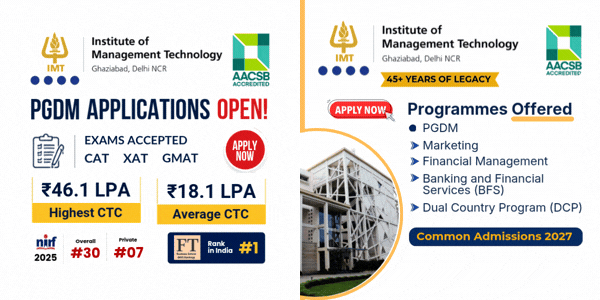
| IMT Ghaziabad | 18.1 LPA |
| IIM Trichy | 18 LPA |
| DMS IIT Kanpur/ IIT Roorkee | 17 LPA (Approx) |
| IIM Kashipur | 14.9 LPA |
The Bottom Line
Degrees, tools, and industry trends will continue to adapt to technological shifts, but the demand for skilled corporate decision-makers remains constant. Registering for CAT / XAT is not just about entering an admission process; it is about securing a seat in the next generation of leadership.


