


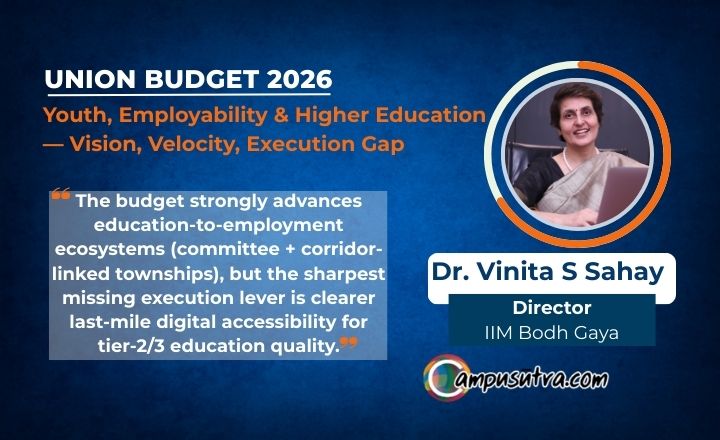
Dr. Vinita S Sahay, Director of the Indian Institute of Management Bodh Gaya, brings her sharp academic insight and policy-oriented perspective to analyze the Union Budget 2026–27. With a career dedicated to shaping management education and aligning institutions with national priorities, she examines how the budget’s provisions resonate with both the everyday citizen and Higher Education Institutions (HEIs).
We requested Dr. Vinita Sahay to comment on the following aspects of the Budget 2026:
- Youth focus
- Employability & industry linkages
- Infrastructure & digital ecosystem
- Research & facilities (towards global research hubs)
- Cost of education/affordability
Her reflections highlight the government’s emphasis on youth empowerment, employability, and industry partnerships, while also addressing the strengthening of infrastructure and the digital ecosystem. She underscores the importance of research and facilities in positioning India’s HEIs as global research hubs, and thoughtfully considers the pressing issue of affordability in education.
Through this lens, Dr. Sahay connects macroeconomic policy with the lived realities of students, educators, and institutions, offering a roadmap for how the budget can catalyze inclusive growth and academic excellence.
Youth focus The Budget is explicitly positioned as “Yuva Shakti-driven” and organised under 3 Kartavya:
- Sustain growth via productivity/competitiveness and resilience,
- Fulfil aspirations and build capacity,
- Ensure inclusive access to resources and opportunities.
Employability & industry
- A High-Powered “Education to Employment and Enterprise” Standing Committee is proposed to recommend measures and assess AI’s impact on jobs and skill requirements.
- Support to States (challenge route) for 5 University Townships near major industrial/logistics corridors—planned to host universities, colleges, research institutions, skill centres, and residences, embedding education into job ecosystems.
- Orange Economy / AVGC skilling: AVGC Content Creator Labs in 15,000 secondary schools and 500 colleges.
Infrastructure & Digital ecosystem
- Continued public infrastructure push: public capex proposed at ₹12.2 lakh crore in FY2026–27.
- Digital/AI is positioned as a governance and delivery force multiplier; a visible example is the National Destination Digital Knowledge Grid to digitally document places of significance and create local work opportunities for researchers/content creators.
Research & facilities (towards global research hubs)
- The University Township model explicitly includes research institutions alongside teaching and skilling infrastructure.
- Additional research-capability signals: five Regional Medical Hubs (integrated healthcare + education + research) and 4 Telescope Infrastructure facilities to be set up/upgraded (Astrophysics/Astronomy).
Cost of education/affordability
- One girls’ hostel in every district (via VGF/capital support).
- TCS on education remittances reduced from 5% to 2% (cash-flow relief for families funding education).
One key “Expectation vs Reality” point (as asked) The budget strongly advances education-to-employment ecosystems (committee + corridor-linked townships), but the sharpest missing execution lever is clearer last-mile digital accessibility for tier-2/3 education quality.
Also read what Directors / Deans of other B Schools had to say.
-
What does the Union Budget 2026-2027 mean to Higher Education? ~ By Prof. (Dr.) V. Jayashree Director, VVISM Hyderabad
-
Union Budget 2026: Nirmala Sitharaman to Engage With Students Post-Budget Presentation
-
From Manpower Supplier to Skill Superpower: Why India Must Invest in Merit ~ Prof B C Patnaik Director NIA Pune
-
Union Budget 2026 and Indian Education: Vision with Velocity, But Not Yet at Scale ~ Ravi Kumar Jain, Pro Vice Chancellor / Director, School of Management, IILM University, Gurugram.
-
Union Budget 2026 – “Human capital at the centre of India’s growth story” – Dr. Debashis Chatterjee, Director, IIM Kozhikode.