


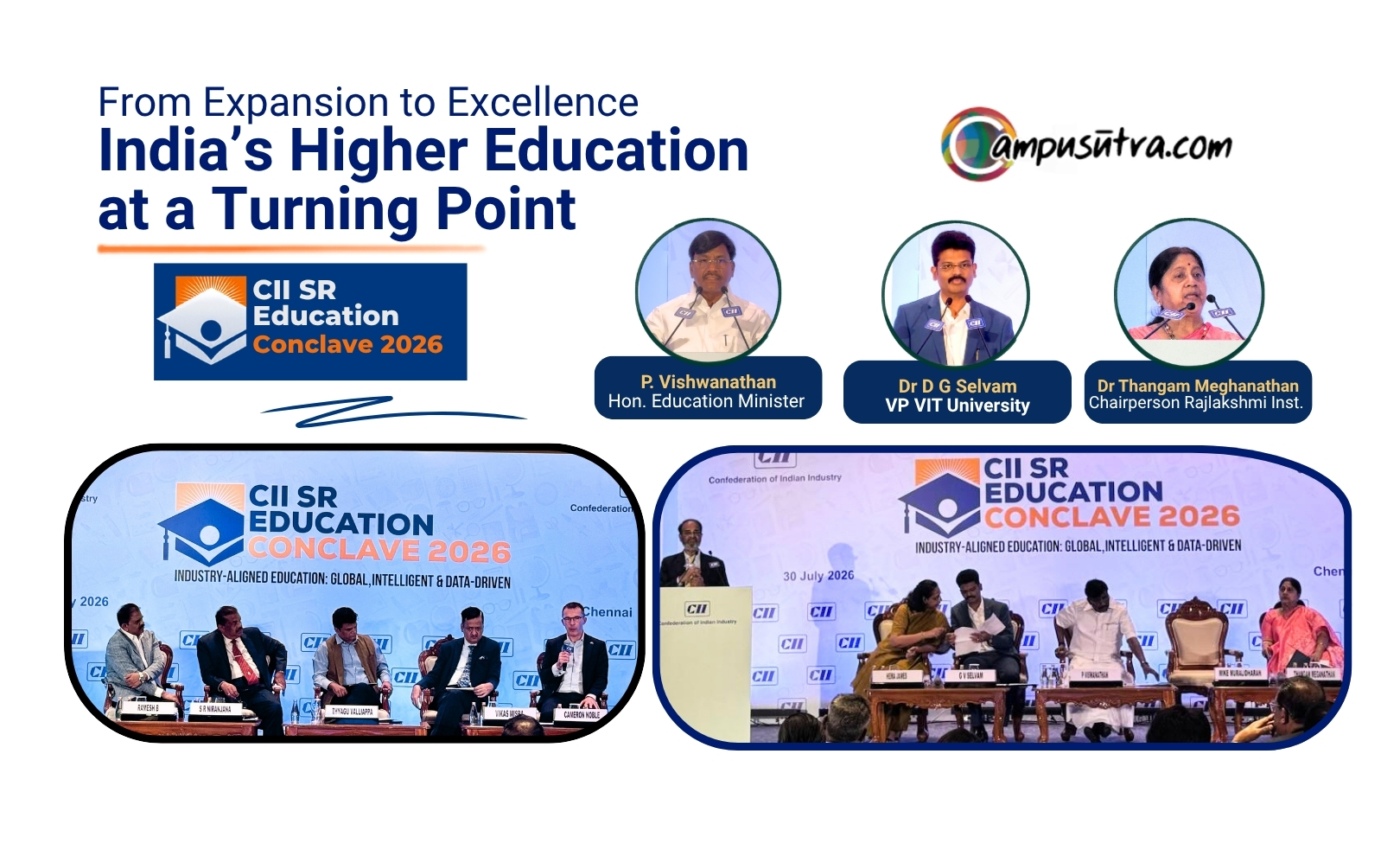
The conversations at the CII SR Education Conclave 2026 in Chennai | Aligned Education: Global, Intelligent & Data-Driven, made one thing abundantly clear: India has entered the next phase of higher education. The challenge is no longer creating more institutions, it is creating institutions that consistently deliver quality, innovation, employability and global competitiveness. The conclave brought together a distinguished cross-section of policymakers, industry leaders, academicians and global education experts. The inaugural session featured Mike Muralidharan, Chairman, CII SR Education Conclave 2026 and Chairman, Ethiraj College for Women, who called for a shift from “Quantity to Quality” in higher education. Dr G. V. Selvam, Chairman of the CII SR Taskforce on Industry-Aligned Education and Skills Pipeline and Vice President of Vellore Institute of Technology (VIT), highlighted the need for stronger industry-academia collaboration. Thiru P. Viswanathan, Hon’ble Minister for Higher Education, Government of Tamil Nadu, stressed that regulatory and bureaucratic processes should facilitate, not hinder, institutional excellence.
Conclave Chairman Mike Muralidharan captured the mood perfectly with a simple yet powerful message: “Quality, not Quantity.” India has built one of the world’s largest higher education ecosystems. But numbers alone cannot determine success. Graduate employability, research impact, industry collaboration and global recognition must now become the real benchmarks.
Dr D G Selvam, said, Quality, Innovation, Agility, Collaboration – is the way ahead.
Regulation Should Enable, Not Delay – Hon. Higher Education Minister of the state, P. Viswanathan, emphasized that governance should facilitate excellence rather than become an obstacle. Universities require greater autonomy and faster decision-making if they are to remain relevant in an increasingly competitive global education landscape. Regulatory compliance is essential, but excessive procedures often slow curriculum reforms, academic innovation and industry partnerships.
Dr Thangam Meghanathan, Chairperson Rajlakshmi Institutions in her Vote of Thanks, mentioned “India’s next leap in higher education will be driven not by numbers, but by excellence.”
Moving Beyond Placement Season: Why Industry Must Co-Own Education
The panel on Internationalisation of Higher Education featured Prof. S. R. Niranjana (Vice Chairman, Karnataka State Higher Education Council), Prof. Ramesh B. (Vice Chancellor, Dr MGR Educational and Research Institute), Mr Cameron Noble (Deputy Consul-General, Australian Consulate-General, Chennai), and Dr Vikas Misra (Vice Chancellor, Hindustan Institute of Technology and Science) – discussed global partnerships, collaborative research, faculty mobility and creating internationally competitive institutions.
Another consistent message was that industry must move beyond recruitment drives and become an active partner in education. Curriculum design, internships, live projects, apprenticeships, faculty interaction, research collaboration and continuous feedback from employers should become integral parts of academic delivery. The gap between classrooms and workplaces can only narrow when academia and industry jointly shape future talent. Building the Future Workforce Demands Active Educational Partnership, beyond Recruitment Drives.
The future lies in combining technology with outstanding faculty rather than treating one as a replacement for the other.
Discussions on intelligent governance highlighted an important distinction.
Artificial Intelligence can personalise learning, improve administration, support decision-making and enhance student engagement. However, technology remains an enabler not a substitute for quality teaching. AI may become an excellent teaching assistant, but inspiring teachers, critical thinking and human mentorship will continue to define great education.
The discussion on Smart, Data and Intelligent Higher Education Governance was moderated by Mr Suchindra Kumar, Partner, PwC India. The panel included Prof. Dr R. Elijah Blessing (Vice Chancellor, Karunya University), Prof. Vignesh Muthuvijayan (Centre for Outreach and Digital Education), Dr Prafulla Agnihotri (Director, IIM Sirmaur), Mr Hemant Sahal (Founder & CEO, Digii) and Ms Kokil Kamra (Group Head – People & Operational Excellence, Kosh Innovations Pvt Ltd.). The panel underscored that while AI and data analytics can transform governance and personalise learning, they should strengthen—not replace—high-quality teaching and academic leadership.
Higher Education Must Fuel Regional Growth
One of the strongest themes of the conclave was that universities should no longer be viewed merely as degree-awarding institutions. They are catalysts for regional economic development. Strong universities create skilled talent, encourage entrepreneurship, support startups, enable applied research and attract industry investments. Every successful knowledge ecosystem—from Bengaluru to Hyderabad and Chennai—demonstrates that higher education institutions are central to economic competitiveness.
When academia, government and industry collaborate effectively, education becomes a driver of innovation, employment and regional prosperity.
Internationalisation Requires Collaboration, Not Just Student Exchanges
Globalisation of higher education extends far beyond sending students abroad.
Institutions must actively pursue joint research, faculty mobility, dual-degree programmes, international partnerships and collaborative innovation. Building globally connected universities requires long-term partnerships rather than isolated initiatives.
The repeated message from the conclave was simple: walk together if India wants to compete globally.
The concluding session on Higher Education Fueling the Regional Economy was moderated by Mr Srikanth Talluri, Founder of 6D Varsity and Co-Convenor, CII Telangana Education & Skills Panel. Panellists included Dr Nagarajan Malmurugan (Vice Chancellor, St. Peter’s Institute of Higher Education and Research), Mr Vijay Shekhar Pandey (Director of Training, Board of Apprenticeship Training – Southern Region) and Mr Rajesh Kumar (Co-Founder & CEO, Kalvium Labs). The discussion reinforced that universities are not merely centres of learning but critical drivers of regional economic growth, entrepreneurship, innovation and workforce development.
The New Scorecard
The success of Indian higher education should now be measured through outcomes that matter:
- Graduate employability
- Quality of teaching and learning
- Industry participation
- Research and innovation
- Entrepreneurship and startup creation
- Global academic collaborations
- Regional economic impact
- Effective use of AI and data-driven governance
The message from the CII SR Education Conclave 2026 is unmistakable: India doesn’t need just degrees. It needs graduates who can create value for industry, for society and for the nation’s economic future.


