



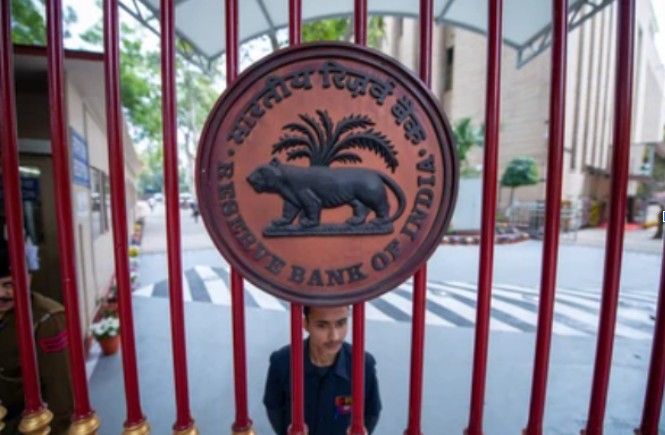
A lot of RBI Grade B applicants will be told this at one time in their application process or preparation or while waiting for the next RBI Grade B notification.
“RBI officers have the option to get an MBA under RBI’s assistance.”
At first, it sounds unbelievable.
But it does happen.
Apply to any top 250 B Schools from one window. Shortlist, save. CLICK
As part of the Reserve Bank of India‘s Golden Jubilee Scheme, the RBI supports selected serving officers who wish to pursue a Master’s in Business Administration (MBA) or equivalent management degree at prestigious institutions, subject to the RBI’s rules and approval processes.
The purpose of this article is to explain how RBI officers may pursue an MBA, which organizations and entities are involved, how eligibility is determined, and what options become available to RBI officers upon completion of an MBA.
Why RBI Introduced the Golden Jubilee Scheme?
In 1985, RBI completed fifty years as an institution. It became obvious that RBI by that time had evolved into a central role in India’s financial system.
RBI recognized a very real fact.
- Central banks have to continue working in areas that are always changing.
- Monetary policy is constantly evolving.
- As the complexity of the financial market increases, so does banking regulation.
- Technical risk management and payment systems increase.
- Understanding global finance becomes increasingly important.
RBI realized that developing long-term institutional success could not be accomplished simply through routine training for officers
They would need a series of structured learning experiences that would allow them to develop an increased level of academic knowledge and the ability to think at the highest levels.
To take care of all these scenarios, RBI came up with the Golden Jubilee Scheme. It is not mentioned in the RBI Grade B notification but is an incredible perk of being an officer in the RBI.
NIA Pune Admission 2026. PGDM Application Open Now
To accomplish this objective RBI came up with the Golden Jubilee Scheme.
Why does the RBI support MBA for its officers?
The RBI is a bank regulator.
But it’s also a big complex organization.
Senior officers are responsible for:
- regulating banks
- supervising financial institutions
- managing risk
- executing policy
- planning for the institution
- making personnel decisions
Over the years, the RBI realized that while you can develop some of your leadership abilities through experience, formal education in business management (MBA) provides additional value in areas such as strategy, decision making, organizational leadership, finance, and executing policy at scale which cannot just be gained by passing RBI Grade B exam after covering RBI Grade B syllabus.
This is the reason the RBI allows selected officers to pursue an MBA under the golden jubilee scheme.
Minimum Service Requirement for MBA Sponsorship
To be eligible for an MBA under the Golden Jubilee Scheme, an officer must have:
- Confirmed RBI Officer status
- Completed at least five years of service as of the time of application to support MBA sponsorship (as determined by RBI internal policy)
- Has a satisfactory service history.
LBSIM PGDM Admission 2026. Application Open
Thus, the Minimum Service Requirement is to ensure that:
- Only applicants who have experience working in RBI will be eligible to be sponsored for an MBA
- Applicants who have been with RBI long enough to demonstrate their commitment to RBI will be eligible to be sponsored for an MBA
- RBI will be investing in officers who have shown a willingness to make a longer-term commitment to RBI
Applicants who are freshly recruited by RBI will not be eligible to be sponsored for an MBA.
Performance and Relevance Criteria
While length of service is one criterion, the officer’s performance and relevance to RBI will also be evaluated as follows;
- An officer’s performance history must reflect consistent satisfactory or high levels of performance
- Provide a link demonstrating the relevance of the MBA to RBI’s functions
- Clearly demonstrate the connection between the program of study and the officer’s current position or potential future positions
- Approval is based on institutional needs versus personal preference.
Internal Approval Process For MBA
The approval process begins within RBI.
Typically, this includes:
- Internal Circular/Invitation from RBI for an MBA
- Submission of a formal application for an MBA
- Written explanation as to why an MBA is necessary
- Details of the proposed institution and/or program of study
- Review of applications by RBI internal committee(s)
- Interviews/Evaluations (as deemed necessary)
There are a limited number of RBI Officers that can be approved for an MBA in each cycle.
This is a selective process.
Admission to MBA Institutes
After receiving internal approval, the officer applies to MBA programs on their own.
Key Points:
- The admission process is based on a merit system.
- RBI does not interfere with the selection process of MBA programs.
- To gain admission, the officer must have met all requirements of the academic qualifications and/or professional experience.
Sponsorship from RBI will begin when the officer has gained admission to an MBA program.
Financial Support for MBA Under the Scheme
RBI will provide financial assistance for the approved MBA as per the RBI’s service rules.
Examples of the financial assistance include:
- Reimbursement of approved tuition fees;
- Prescribed academic expenses;
- Financial assistance during the duration of study;
- And study leave as per RBI regulations.
When an MBA program is offered internationally (overseas), the costs associated with the program can be quite high.
In terms of providing approved expense reimbursement, the level of RBI support for the international MBA program is limited by internal limits and sanctioned amounts.
While there is not a fixed amount, the level of RBI support is sufficient so that officers are able to obtain an approved MBA without taking out a personal loan for education purposes.
Officer’s Status During the MBA
- The Officer will be on approved study leave
- All RBI Service Rules will continue to apply
- All Conduct & Discipline Regulations will continue to apply
The Officer’s participation in the MBA Program will be viewed as part of their Structured Service Development
Service Bond After MBA
An MBA Service Obligation is a mandatory requirement for all Officers who are sponsored for an MBA.
Following completion of the MBA program:
- Officers must serve the RBI for a certain number of years
If an Officer fails to complete their Service Obligation before leaving RBI:
- They will be obligated to repay the sponsored costs associated with their MBA education
Thus, the RBI’s investment in sponsoring the officers’ education is protected.
What Happens After Completing the MBA
Upon completion of the MBA program:
- The Officer will return to RBI
- The Officer will resume service at RBI under RBI’s normal rules & regulations
- Assignment/Promotion/Posting decisions will continue to be made by RBI
Generally, Officers with an MBA will be eligible for assignment to:
- Leadership and policy positions within RBI
- Departments that have strategic functions
- Positions that require management skills.
Although there is no automatic promotion or “fast track” promotion upon returning to RBI, the Officers’ experience and education earned through participation in the MBA program should enhance opportunities for career advancement based on RBI’s normal promotion process.
Why This MBA Opportunity Is Unique
Many professionals will face a decision in their careers either to continue in their present job role or to stop working in order to go back to an MBA school.
RBI officers do not have to make this type of trade-off.
- Continuity in career can be maintained through the Golden Jubilee Scheme
- MBA formal education can be pursued through the Golden Jubilee Scheme
- The needs of the RBI can remain as the focus
As there are very few government institutions that provide such a structured path to support an employee’s continued education at all levels (including top management education), RBI provides its employees with both stability and structured professional development opportunities.