



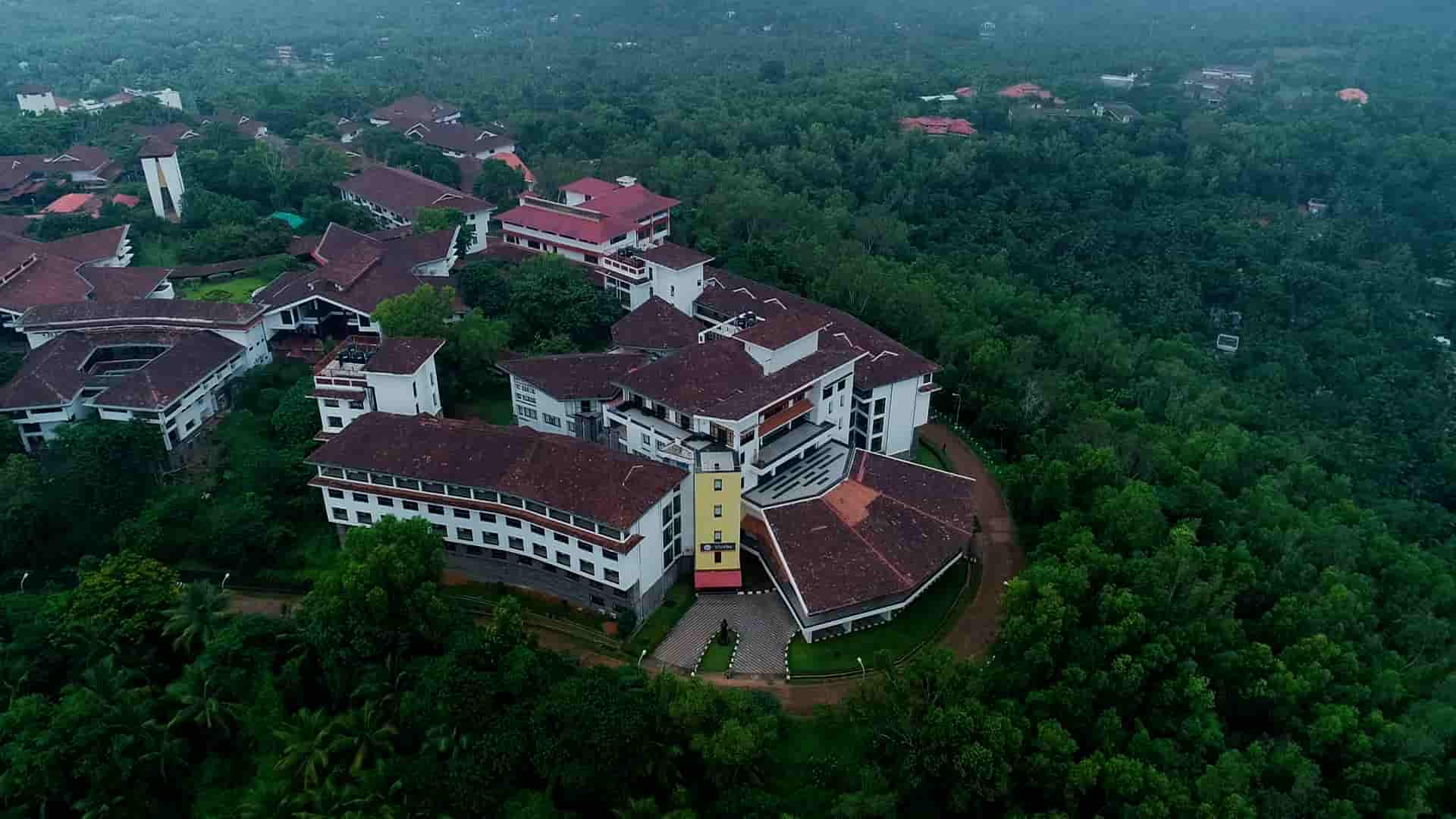
Mumbai, 16 January, 2026: A team of experts from the Indian Institute of Management Kozhikode (IIMK) recently submitted a report laying down the Way Forward for India’s insurance sector towards achieving the Insurance Regulatory Development Authority of India (IRDAI)’s aspirational goal of providing “Insurance for All by 2047”.
IIM Kozhikode Announces Admissions for PhD programme
The report was prepared by Professors – Debashis Chatterjee, Director IIMK, Mridul Saggar, Head of its Centre for Macroeconomics, Banking & Finance, Rudra Sensarma and Shubhasis Dey. It culminated from extensive work and analysis following a deep dive made earlier on diverse issues constraining insurance sector during the deliberations at the two-day offsite meeting (“Manthan”) on August 23-24, 2024, organised by GI & LI Councils in which the then IRDAI Chairman and other stakeholders participated. IIM Kozhikode made presentations at the offsite and different stakeholder industry groups worked to provide deep insights on several aspects.
IIM Kozhikode Placement 2025
Upon the submission of the report Debashis Chatterjee, Director, IIMK shared, “Insurance industry needs to be future ready by harnessing innovations in products and technology. New innovations will destroy older industrial structures by creating newer ones. Like tropism, insurance firms’ best response will be to adapt by innovating processes with aid of technology to survive and thrive in this inevitable process of creative destruction.”
IIM Visakhapatnam PhD Admission 2026. Application Open.
Prof. Mridul Saggar, Head of the IIMK’s Centre for Macroeconomics, Banking & Finance points out that, “Capital infusions or divestment in state-owned insurance firms, including splitting and unbundling of the monopoly in life insurance space can jolt the industry and raise penetration and density. This will also spur fresh investments and M&A activity in private sector, provided they build customer trust. As monopoly gives way to competition, the restructured industry will be enable harnessing of AI-ML-deep learning models giving development agenda and inclusion a real chance.”
The IIMK Report now submitted to the General and Life Insurance Councils, and the IRDAI, concludes that “Insurance for All by 2047” is achievable – but only if it is pursued as a national mission, not a market afterthought. The path forward requires regulatory clarity, technological leapfrogging, capital deepening, and institutional trust. If executed with discipline and imagination, insurance can become a cornerstone of India’s economic resilience, social security architecture, and sustainable growth story.
The IIMK team’s report examined two fundamental questions: (i) how can we provide insurance services to all in India and (ii) how does the insurance industry in India adapt to the ongoing process of creative destruction? It makes several recommendations for the IRDAI, insurance councils and the government to consider for achieving the industry vision for 2047.
Highlights of the Report:
- Despite India being the world’s fourth-largest economy, insurance penetration remains modest at about 3.7% of GDP, with significant gaps in health, property, catastrophe, and small-ticket non-life coverage. However, this is broadly comparable with that of China which has five times India’s per capita GDP. India somewhat lags its peers in insurance density at US$95 partly reflecting in large part low per capita GDP but also indicating scope for considerable insurance deepening in years to come.
- “Insurance for All” should be interpreted as universal access to affordable, appropriate risk protection, irrespective of income, geography, or social status. IRDAI should formally adopt phasing in of a target for a 1+1 coverage – at least one term life policy and one health insurance policy – covering over 60% of the population by 2030, 80%by 2040 and achieve near-universal insurance coverage, including life, health, property, motor, and personal accident insurance for individuals, and comprehensive risk coverage for enterprises by targeting penetration of ~6.3%, comparable to the simple average of the OECD countries in 2024.
- The report notes that affordability is the binding constraint for insurance expansion. The report strongly advocates the creation of low cost Basic Insurance Products (BIPs) through daily or weekly micro-payments, especially for informal workers. UPI-enabled digital payments and wallets as also Business Correspondents and InsurTech platforms can be used for strengthening distribution channels
- It suggests building more heterogenous insurance industry by setting up Insurance Information Bureau and developing public insurance registry Insurance
- A central constraint to insurance deepening s information asymmetry and an open insurance architecture and interoperable data systems based on unique transaction identifiers and interoperable data systems. AI-driven underwriting, fraud detection, and product customization and RegTech can help.
- IRDAI should develop an insurance inclusion index using three-stage Principal Component Analysis and capturing three dimensions – access, Usage and quality
- For developing a heterogenous insurance industry it suggest arried type of licensing – universal insurers, monoline/specialist insurers, and regional or micro-insurers. It also is in favour of “Go Local” strategies with region-specific products.
- Expanded distribution through the IRDAI’ trinity of Bima Vistaar, Bima Sugam, and Bima Vahak, CSCs, post offices, SHGs, retail outlets, and digital marketplacwould help.
- It advocates a swift transition to a Risk-Based Capital (RBC), implementation of Ind AS / IFRS-17 (AS-117) and deepening of the reinsurance market, including subsidiary incorporation by global reinsurers, to support catastrophe and climate risk coverage.
- Suggests provisions in the forthcoming Union budget to either divest state-ownership or recapitalise National Insurance Company, Oriental Insurance Company and United India Insurance which are running negative insolvency ratios. Also to privatize ECGC and capital raising by AIC. The Finance Bill can also propose insurance firms being covered by the IBC.
- It recommends large investments in research and human capital towards use of data science, actuarial skills, AI-ML, cyber risk, and regulatory expertise in partnership with leading academic institutions
- Finally, it makes a recommendation for massive restructuring India’s insurance sector through M&A activity to fully reap creative destruction potential to benefit from digital technology, different types of AI, ML & deep learning models.
- There is no unique optimal number of insurance firms or its break-up by types of firms. It is best to let the number of firms evolve based on fair competition. However, broadly one will expect the number of insurance firms in India to increase from existing 73 to about 120, within a decade from now on the back of further opening up of the sector, its global integration and improved competition in the industry that will help fill-in empty spaces in insurance business. number of reinsurance firms could increase from existing two to about 11 following the Powers-Shubik rule.
- Indian insurance industry is dominated by life segment and within that by Life Insurance Corporation (LIC) that enjoy a virtual monopoly power. Insurance is not a natural monopoly. There appears to be a prima facie case for splitting (demerger), divestment or divestiture and unbundling of LIC business. The government can engage professional merchant banker advisory services to work out the best way for splitting and unbundling its activities to generating efficient and value creating competitive units. This alone with spur enhanced interests of fresh investments in the sector.
IIM Amritsar hosts the 5th International Conference on Management of MSMEs 2026
The IIM Kozhikode team emphasised that achieving “Insurance for All by 2047” will require coordinated action across regulators, insurers, government, technology providers and civil society. The report underscores that insurance must evolve from being a discretionary financial product to becoming a foundational pillar of India’s social protection and economic resilience framework. With timely reforms, technological adoption and institutional trust-building, the sector has the potential to play a transformative role in safeguarding households, enterprises and the broader economy against emerging risks in the decades ahead.
About Indian Institute of Management, Kozhikode: The fifth IIM to be established by Govt. of India in 1996, IIMK started its academic journey in 1997 with its flagship Postgraduate Program (PGP). The Institute is on a high growth trajectory today, offering widest range of academic programs in the field of management education. These include Doctoral Programme in Management (PhD), Executive PG Programmes, Management Development Programmes and Faculty Development Programs. IIMK set up a Satellite campus at Infopark, Kochi, in 2013 dedicated to Executive Education. IIMK has also the unique distinction of launching a PhD (Practice Track) programme for working professionals besides bringing in new dynamic courses like one-year Post Graduate programme in Business Leadership (2019) MBA in Finance and MBA in Liberal Studies & Management (2020). IIM Kozhikode also launched a one-of-its kind 4-year full-time undergraduate programme – Bachelor of Management studies in 2025. The institute is also home to IIMK LIVE a first-of-its-kind startup incubation programme, the Indian Business Museum and seven other Centres of Excellences encompassing diverse areas. IIMK is ranked 3rd as per NIRF India Rankings 2025: Management. The institute also made its global debut for its flagship MBA and EMBA programme in the 2020/21 QS World University Rankings. In 2023, IIM Kozhikode also broke into Top-100 in Financial Times Ranking for Masters in Management (MBA) and gained 9 spots in 2024 to reach global #68. The Institute also attained global rank #70 in the FT Open Enrolment Programme for 2024. The Institute is globally accredited by EQUIS (EFMD) and AMBA (UK).
Submitted by Mr. Vikas Panicker