


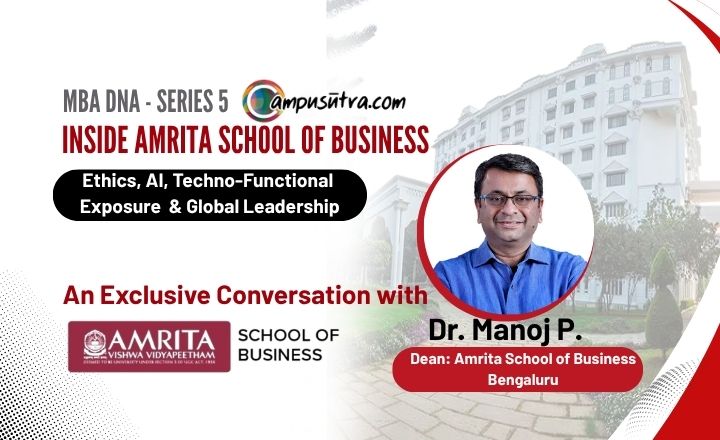
Greetings from Team Campusutra , Sir!
- How does Amrita School of Business (ASB) specifically integrate value-based education into a modern, data-driven MBA curriculum and emphasizes a “perfect blend of academic rigor and ethical grounding.”
At ASB, we believe in “Education for Life,” a philosophy guided by our Chancellor, Sri Mata Amritanandamayi Devi (Amma). This is not merely a slogan but is integrated into the curriculum through core courses. These days, when AI and Automation have been reported to take over many of the traditional work opportunities, we believe that human qualities will be more and more valued, and courses like Managerial Values and Business Ethics, are very important core subjects that remind students of this. Students are encouraged to develop a “solution mindset” grounded in high ethical standards. A prime example of this integration is our Live-in-Labs program, where students apply classroom knowledge to solve sustainable business challenges in rural India, fostering compassion-driven research and practical ethics.
Breaking Barriers, Building Leaders: LIVE with Director, MDI Gurgaon
2. In a crowded market of top-tier private B-schools – IIMs or DoMs at IITs, How should Amrita School of Business be Benchmarked & Differentiated : what do you consider ASB’s “USP” ?
Our primary differentiator is the dual-degree collaboration with the University at Buffalo (UB), a premier, research-intensive top-ranked public university in the U.S.. Graduates earn two distinct degrees – an MBA from Amrita and an MS in Business Analytics and Systems from UB, in the same duration and at a competitive cost. Other USPs include international exposure via a four-week study program at the UB New York campus, WES recognition for global career mobility, and a curriculum delivered by distinguished global faculty.
Q3: With the introduction of the Amrita Common Aptitude Test (ACAT), what specific attributes are you looking for during the personal interview stage?
While ACAT assesses verbal reasoning, data interpretation, and quantitative aptitude, the personal interview focuses on identifying candidates with a “solution mindset” and strong ethical foundations. We look for students who demonstrate the potential for leadership and the ability to think critically. Candidates with work experience are viewed favorably as they bring practical perspectives to the peer-learning environment.
Evaluate, Select, APPLY – Entire List of 200+ Top B Schools : CLICK HERE !
Q 4. Beyond gender & cultural diversity goals, how is ASB working to attract “non-traditional” candidates such as those from Humanities, Law, or Fine Arts to enrich the peer-to-peer learning experience?
As a multi-disciplinary university offering programs in Law, Arts, and Social Sciences, Amrita naturally fosters an environment where diverse perspectives meet. The MBA-MS program is open to graduates from any bachelor’s degree with a minimum of 60% marks. Our curriculum is designed to be inclusive, allowing students from non-technical backgrounds to thrive by bridging functional management with analytical tools like R and statistics.
Q 5. ASB also offers AI & Business Analytics. How are you bridging the gap between technical data science and functional management leadership?
We offer a techno-functional exposure that teaches students to use analytical techniques to derive actionable business insights. The curriculum integrates technical skills like IT project management, systems analysis, and machine learning with core management functions in Marketing, Finance, and HR. This ensures students don’t just process data but use it to hit business marks and solve complex organizational problems.
Q 6. How does the Dual Degree program with the University at Buffalo (USA) specifically prepare students for international careers compared to a standard Indian MBA?
Beyond the dual credentials, the program offers a global perspective through international faculty and the Leadership Empowerment Academy Program (LEAP) offered by UB. The mandatory four-week study trip to New York immerses students in U.S. business practices and international learning environments. Furthermore, the MS degree in Business Analytics and Systems is tailored to the global demand for data-driven managers, and WES recognition simplifies the process of working abroad.
The Next-Gen MBA Blueprint : Non-Negotiable Shifts. Live with Director, GIM Goa
Q7. The 2025 data shows a highest CTC of ₹24.84 LPA and an average of ₹8.33 LPA. Which sectors are driving this growth, and how are you maintaining these numbers across your five campus locations? What type of recruiters would you love to see more in the placement season ?
Growth is driven by a diverse range of sectors, with top recruiters including global firms like Oracle, Deloitte, BNY Mellon, Federal Bank, and TCS. Our dedicated Corporate Industry Relations (CIR) department manages career development and placements centrally, ensuring students across campuses receive expert guidance, specialized training, and access to over 100 recruiting companies.
Q 8. With scholarships offering up to a 75% fee waiver for high achievers, how do you measure the “Return on Investment” for a student ? Any particular advice for Campusutra students applying for Scholarships at ASB apart from acads?
With a highest CTC of ₹24.84 LPA against a tuition fee of approximately ₹12.1 Lakhs for two years, the ROI is substantial. Scholarships of up to 75% fee waiver significantly enhance this ROI for high achievers. My advice to Campusutra students: Scholarships are not just about the initial test score; they require consistent academic performance (CGPA of 8.5+) and a certificate of good conduct for renewal in the second year.
Dr. Maneesha Vinodini Ramesh Takes Charge as Pro VC of Amrita University
Q 9. With 2,000+ alumni in top global companies, how does ASB leverage this network for mentorship projects to give current students a competitive edge?
We bridge the gap between students and alumni through Colloquium sessions, where industry professionals and alumni share their real-world experiences and act as mentors. This network is instrumental in providing students with industry exposure and helps them “grab new opportunities” in the competitive job market. Our students also get the opportunity to join the University at Buffalo’s global alumni network of over 280,000 professionals across 150+ countries. This network opens doors to mentorship, job referrals, global career opportunities, and industry connections that support long-term professional growth.
Q 10. What do you think is missing the most in the current Indian MBA pedagogy / curriculum ? And how is Amrita working in that area ?
Many Indian programs remain overly theoretical. Amrita addresses this by emphasizing experiential and immersive learning. Between Live-in-Labs for social impact and the international stint at UB for global strategy, we ensure our students “unlearn and learn” in diverse conditions. We move beyond textbooks to foster critical thinking, adaptability, and leadership through a curriculum that is continuously fine-tuned to the changing global business landscape.


