


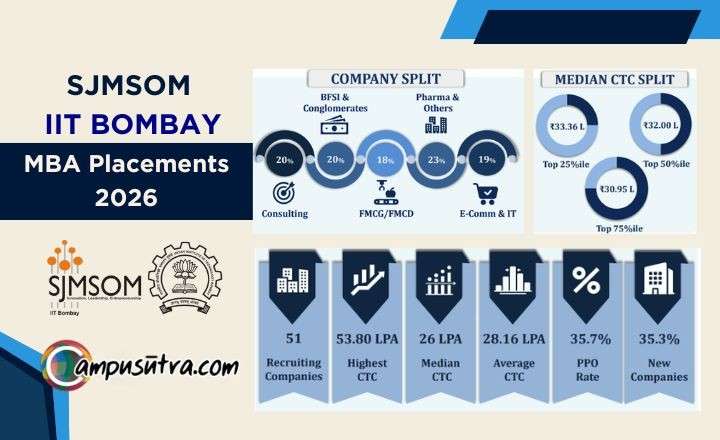
SJMSOM MBA Placements 2026: The final placement season for the MBA batch of 2024-26 at the Shailesh J. Mehta School of Management (SJMSOM), IIT Bombay (Indian Institute of Technology Bombay), concluded 100% placements.
Apply to any top 250 B Schools from one window. Shortlist, save. CLICK
MBA Placement Highlights
- Average Annual CTC: ₹28.16 LPA
- Median Annual CTC: ₹26 LPA
- Highest Annual CTC: ₹53.80 LPA
- PPO Rate: 35.7% of the batch received Pre-Placement Offers
- New Recruiters: 35.3% of the total companies were first-time participants.
XAT Accepting B Schools Opens Application ~ XLRI, XIMB, IMT, IMI, LBSIM, LIBA
IIMA launches Online MBA programme in Business Analytics & AI
Sector-Wise Placements
- Consulting: 26% of the students secured roles in consulting from firms like Accenture Strategy, Deloitte, EY, Kearney, PwC, and Capgemini. Profiles included Management Consulting, Strategy Consulting, and M&A.
Compare MBA Colleges: SJMSOM vs IIM Mumbai vs VGSoM vs DMS IIT Delhi
- IT/ITeS & E-Commerce: Together, these sectors recruited a significant portion of the batch (26% for E-Commerce & IT). Major recruiters included Amazon, Flipkart, Zepto, Mastercard, and Accenture, offering roles in Product Management, Operations, and Technology Consulting.
- BFSI & Conglomerates: 21% of the batch was placed here. Key recruiters included JPMorgan Chase & Co., Nomura, ICICI Bank, Axis Bank, and TAS (Tata Administrative Services).
- FMCG/FMCD: Accounting for 11% of the student split, this sector featured industry leaders like Hindustan Unilever Limited, P&G, Mondelēz International, Marico, and Asian Paints.
- Pharma & Others: 16% of students joined sectors like Pharma and real estate, with recruiters such as Lupin, Truemeds, Mahindra & Mahindra, and Saint-Gobain.
DMS IIT MBA Admission, NIT Placements
Batch Profile
- Median CAT Percentile: 98.87
- Work Experience: 85% of the batch joined with prior work experience, averaging 25 months.
- Diverse Backgrounds: While 85% had work experience, the batch also included 15% freshers. Engineering backgrounds dominated the education split, with CS/IT (29%) and Mechanical Engineering (26%) being the largest groups.


