


Greetings, Fr. George ! On behalf of the Campusutra team, we would like to extend our sincere gratitude for the consistent support you’ve provided for our various collaborations.
Fr. S. George, S.J., the Director of XLRI Jamshedpur, needs no formal introduction. A leader who seamlessly blends the wisdom of Jesuit philosophy with the high-octane demands of modern management.
In an era of rapid technological disruption, Fr. George stands as a guardian of “the human element,” ensuring that while XLRI looks toward the future, it never loses its soul. In the following dialogue, he unpacks the strategic evolution of the Xavier Aptitude Test (XAT) as one of the most popular MBA entrance exam after CAT; XAT and XLRI’s future plans, debunking the “elephant in the room” regarding MBA – which is not merely a shortcut to high salaries or corporate power but transformational journey.
Let’s dive into the Q&A.
1 : Fr. George, last year around the same time we at Campusutra quoted you attributing the record-breaking surge in XAT 2025 registrations to its ‘comprehensive and versatile’ testing framework. We are keen to hear from you on XAT 2026 ? And what is the ‘XAT 2027 Roadmap’ to ensure that this exam remains the gold standard for versatility ?
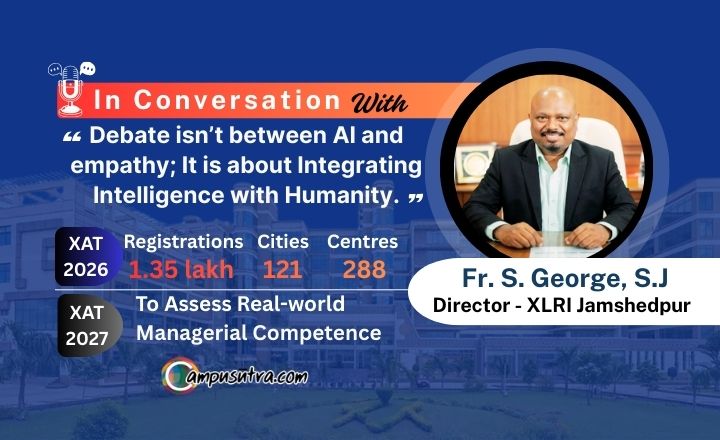
XAT 2026 has once again reaffirmed its standing as one of India’s most credible and comprehensive management entrance examinations. With approximately 1.35 lakh registrations and smooth, glitch-free conduct across 121 cities and 288 test centres, the examination reflected XLRI’s commitment to fairness, transparency and operational excellence.
What sets XAT apart is its ability to assess managerial aptitude holistically, evaluating not only quantitative aptitude and verbal ability but also decision-making and general awareness.
As we chart the XAT 2027 roadmap, our focus is on future-proofing the assessment framework. We aim to deepen XAT’s capability to measure real-world managerial competence, reinforce its integrity and analytical depth, and continuously align it with the evolving demands of leadership in a complex, digital and uncertain world. Our goal is to ensure XAT continues to represent the gold standard in versatility and rigour.
Breaking Barriers, Building Leaders: LIVE with Director, MDI Gurgaon
2 : How does XLRI plan to further strengthen XAT’s positioning as the most versatile gateway for management institutes in India amidst few top B Schools moving out of XAT?
XAT’s strength lies not in the number of institutions that adopt it but in the depth, credibility and integrity of what it measures. For decades, it has earned the trust of aspirants by prioritizing substance over superficial performance.
We remain committed to enhancing XAT’s academic robustness, industry relevance, and ethical foundation. Its distinctive emphasis on decision-making, problem-solving acumen and ethical reasoning ensures that it remains one of the most trusted gateways to premier management education in India.
3 : Fr. George, you are steering an institution that has been the ‘conscience keeper’ of Indian management education ever since the first batch graduated in 1958. As Director in 2026, how do you balance the weight of this 70-year-old legacy when the definition of a ‘Business leader’ has changed drastically?
XLRI’s legacy is not merely historical; it is a responsibility to uphold conscience, character and excellence in management education. Since 1949, the institution has stood for values-driven leadership and that core remains unchanged.
What has evolved is the context in which leaders operate. Today’s business leaders must be globally aware, technologically fluent, ethically grounded and socially responsible. Our mission is to honour XLRI’s heritage and take it forward while preparing leaders who can thrive in a world of rapid transformation without losing their values.
The Next-Gen MBA Blueprint : Non-Negotiable Shifts. Live with Director, GIM Goa
4: Looking back at this journey, what is the one ‘XLRI DNA’ trait you want to retain and one trait you feel that the time has come to let go or want to shred?
The defining trait we must preserve is XLRI’s commitment to competence with conscience, excellence guided by ethics and responsibility.
At the same time, we must consciously let go of any complacency that can arise from legacy alone. Tradition must serve as a foundation for innovation, not a constraint. XLRI must continue to be rooted in values while remaining forward-looking, agile and experimental.
5 : We see a fascinating tension in XLRI’s current trajectory. On one hand, your personal philosophy of empathy and ethics that are uniquely human domains and on the other hand, XLRI is aggressively scaling AI Research and Application and integrating Gen-AI into the very ‘human’ heart of HR and Supply Chain curricula. In this high-tech, high-touch environment, is it a – “AI vs. Empathy” deliberation ? How is ‘AI Resilience’ being defined at XLRI ?
This is not a debate between AI and empathy; it is about integrating intelligence with humanity.
At XLRI, technology is viewed as an enabler, not a replacement for human judgment. While we actively embed AI and GenAI into our courses, we remain firmly committed to nurturing ethical sensitivity, emotional intelligence, and human-centred leadership.
We define AI Resilience as the capacity to leverage technology responsibly, uphold ethics and ensure that leaders remain deeply sensitive towards human values in a high-tech world.
MBA is a transformative journey or just a placement outcome? : LIVE with the New Age ‘Mastermoshai’
6 : Historically, PGDM programmes were regarded as being more closely aligned with industry needs than conventional MBA offerings of central and state universities. The establishment of the IIMs further reinforced this, as they were granted curriculum autonomy beyond the traditional university to respond directly to evolving market demands. However, over the last few years except 6 IIMs, most have largely moved toward the ‘MBA’. At Campusutra, we often have to counsel students that recruiters value competency, not the nomenclature of degree or diploma. Does XLRI feel any pressure or do you believe that the ‘XLRI PGDM’ has become a brand so powerful that it transcends the need for a degree title?
In today’s recruitment ecosystem, employers are increasingly competency-driven rather than degree-driven. What matters is capability, adaptability, integrity and performance, not nomenclature.
XLRI’s PGDM is a powerful and respected brand in its own right, built on academic autonomy, strong industry alignment, and leadership excellence. We do not feel pressure to follow naming trends because our graduates’ impact speaks louder than labels.
7 : XLRI has expanded within India through Delhi NCR campus and now Amravati. Could students expect XLRI to open an international campus in the future? For Fr. George, is the bigger goal to chase international benchmarks, or to reinforce XLRI’s role as India’s most preferred B-school?
XLRI’s expansion within India reflects our commitment to making high-quality management education more accessible while maintaining rigorous academic standards.
On the global front, our priority is not merely geographic expansion but globalizing the XLRI brand through international collaborations, joint programs, faculty exchange, research partnerships, and global immersion opportunities. Our ambition is to meet international benchmarks while strengthening XLRI’s position as India’s most preferred B-school.
8 : And when it comes to admissions, what are the two most crucial traits looked for in an applicant during the interview process at XLRI?
Two attributes we deeply value are:
First, the ability to think critically and make sound decisions in complex and ambiguous situations.
Second, a strong ethical foundation reflected through authenticity, perseverance, and integrity.
We seek individuals who combine intellectual depth with emotional maturity and a principled value system.
9 : What’s the most unconventional career path you’ve seen a XLRI graduate take that made you think ‘Wow, I never saw that coming’?
Over the years, XLRI graduates have taken inspiring paths beyond traditional corporate roles, from social entrepreneurship and public policy to sustainability ventures, creative industries, and grassroots leadership.
What stands out is not how unconventional these paths are but the courage, conviction and purpose with which our alumni define success. Their journeys reaffirm that true leadership is measured by impact, not titles.
10 : What’s the biggest myth about MBA education that you’d like to bust for Campusutra.com readers?
The biggest misconception is that an MBA is merely a shortcut to high salaries or corporate power.
In reality, an MBA, especially at XLRI, is a transformational journey. It shapes judgment, resilience, adaptability, ethical awareness and leadership maturity.
An MBA does not guarantee success.
But it equips individuals with the mindset, skills and values needed to create success that is responsible, meaningful, and aligned with the greater good.