


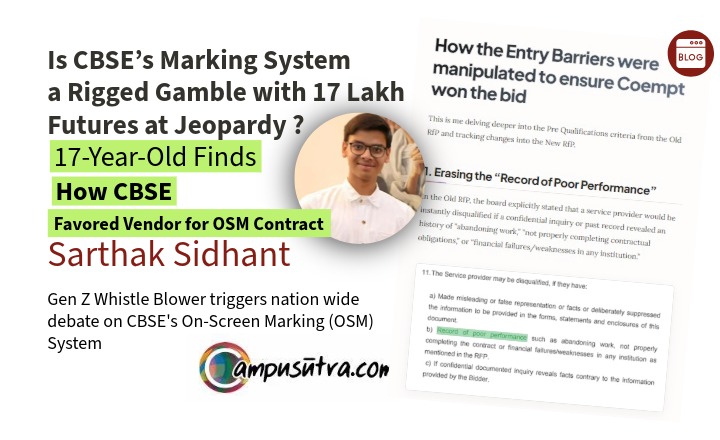
New Delhi, June 03, 2026: As if the recent NEET fiasco was not enough to shake the foundations of India’s education system, a new controversy has erupted, this time centered around the Central Board of Secondary Education (CBSE). At the heart of this storm is Sarthak Sidhant, a Class 12 student from Jharkhand, whose meticulous investigation into CBSE’s On-Screen Marking (OSM) system has exposed a web of alleged irregularities, rule manipulations, and a blatant disregard for student futures.
Sidhant’s findings, published in his viral blog titled “How CBSE rewrote rules to favour Coempt EduTeck,” have not only ignited a political row but also led to his appearance before the Parliamentary Standing Committee to present his evidence.
The Whistleblower: A Gen Z Turns Detective
Sarthak Sidhant is not just any student; he is one of the 17 lakh students directly affected by the OSM system introduced for the 2025-26 academic year. Driven by a quest for transparency, Sidhant scoured through hundreds of pages of CBSE’s Request for Proposal (RFP) documents, comparing multiple versions of tenders to trace how the rules were systematically modified.
His investigation claims that CBSE deliberately lowered the bar to favor a specific vendor, Coempt Edu Teck, a company with a controversial past.
The Rebranding of a Failed Legacy
One of the most damning revelations in Sidhant’s report is the history of Coempt Edu Teck. According to his research, the company was formerly known as Globarena Technologies—the same firm responsible for the 2019 Telangana Intermediate exam fiasco, where systemic failures led to missing marks for 3.8 lakh students and tragically resulted in 23 student suicides.
Sidhant alleges that Globarena rebranded to Coempt Edu Teck just six months after the Telangana crisis, and CBSE failed to perform the necessary due diligence to disqualify a firm with such a “catastrophic, disgusting, and vile” track record.
Find the Original Blog by Sarthak Sidhant below where he step by step shared the findings.
This investigation gained national traction, resulting in Sidhant testifying before the Parliamentary Standing Committee on Education and prompting the government to launch an inquiry into the procurement and replace the CBSE chairman.
How the Rules Were Rewritten: A Systematic Dilution
Sidhant’s blog outlines several key areas where CBSE allegedly manipulated its own procurement process:
| Alleged Manipulation | Impact of Change |
|---|---|
| Erasing “Record of Poor Performance” | Removed clauses that would have disqualified vendors with a history of “abandoning work” or “financial failures.” |
| Subtle Shift in Blacklisting Clause | Changed “Blacklisted earlier” to “Currently Blacklisted,” effectively sanitizing the history of rebranded firms. |
| Lowering Software Quality Standards | Dropped the required CMMI level from 5 to 3, allowing less mature software platforms to handle sensitive student data. |
| Halving the “Cooling-Off” Period | Reduced the window for “corrupt practices” involving former board officials from two years to just one year. |
| Relaxing Infrastructure Requirements | Removed the mandate for bidders to own their own Data Centers, allowing the use of third-party cloud services like AWS and Azure. |
| Diluting Penalty Clauses | Erased the word “Blacklisting” from penalty matrices and prioritized “rushed results” over accuracy. |
A New Pandora’s Box in Indian Education
Sidhant’s investigation highlights a “procedural collapse” within one of India’s most trusted public institutions. By bypassing mandatory CERT-In security audits and ignoring mathematical thresholds for error rates, CBSE has allegedly gambled with the data security and mental health of millions of students.
“This is a story of how a massive public institution deliberately played with students’ futures by rewriting its own rulebook,” Sidhant writes in his blog. “They gambled with our data security, our marks, and our mental health. The Institution failed us.”
The Road Ahead: Seeking Accountability
The “Sidhant Investigation” has opened a new Pandora’s box, raising fundamental questions about the integrity of digital evaluation systems in India. As the Parliamentary Standing Committee reviews his seven-page document of anomalies, the pressure is mounting on CBSE to provide clarity and answer the tough questions posed by a 17-year-old who refused to be a silent victim of a sub-optimal system.
For an education scenario already reeling from the NEET controversy, Sarthak Sidhant’s efforts serve as a stark reminder that India’s Gen Z is not just tech-savvy but they are fearless in their pursuit of accountability.
“how cbse rewrote rules to favor coempt eduteck,” Sarthak Sidhant’s Blog, May 2026.


