


Campusutra: Greetings Dr. Atish. Thank you for always being a source of inspiration and encouragement for Team Campusutra. Face to face with – the new age ‘Mastermoshai’, is always a thrilling experience. You spark ideas in every direction. Your contributions to Campusutra.com have always been very rich, interesting and thought provoking.
1 : You led SPJIMR, MICA, and JAGSoM to next level recognitions. What led to the strategic return ? Any ‘unfinished business’ or opportunity that brought you back to IMT Ghaziabad in 2025?
I have been fortunate to share a deep personal and professional rapport with every institution I have worked with—IBS, SPJIMR in Mumbai, MICA in Ahmedabad, and JAGSoM in Bengaluru. My tenure as Director of JAGSoM and Vice-Chancellor of Vijaybhoomi University was both fulfilling and impactful.
When the opportunity arose to return to IMT Ghaziabad, the Board was keen, and I felt equally drawn to the institution. Building an academic institution is an ongoing agenda —it is a continuous, collective process shaped by shared values and everyday actions.
IMT Ghaziabad stands on a strong 45-year legacy, an excellent faculty base, a powerful alumni network, and deep industry and community linkages. As we move forward, we are focused on four strategic priorities:
- Deepening industry integration and aligning curricula with evolving role requirements
- Driving digital transformation
- Accelerating internationalisation
- Strengthening alumni engagement
Breaking Barriers, Building Leaders: LIVE with Director, MDI Gurgaon
2: Talking about the ‘Homecoming’ – How is the IMT Ghaziabad of today different from the one you led nearly seven years ago?
The context in which institutions operate today is fundamentally different. Disruption is no longer episodic—it is the new normal.
Indian Business Schools are navigating digital disruption, geopolitical turbulence, global competition, and rapidly changing workforce expectations. IMT Ghaziabad today is consciously adapting to this reality—through curriculum redesign, deeper industry partnerships, technology integration, and focused skill development.
The institution is now better positioned to respond to AI-led disruption, shifts in the global economy, and changing student aspirations, while remaining rooted in its academic values.
3 : You’ve criticized the traditional ‘one-size-fits-all’ MBA and also created a role driven process for selection of specialisation in your last stint. Could you explain how that ‘Role-Driven’ process works and how it will help students curate their own career pathways?
Companies today do not have the time or bandwidth to groom talent. Graduates must be role-ready from Day Zero. Hiring has decisively moved away from generic management trainee roles to role-specific profiles—performance marketer, marketing analyst, investment banker, supply-chain planner.
At IMT Ghaziabad, we start with actual job descriptions from recruiters. Each JD outlines key responsibilities and KPIs, which become the foundation for identifying the competencies required for success. These competencies are grouped into technical, functional, and behavioural dimensions and are further mapped to skills, knowledge areas, and tools.
We have institutionalised this through a dedicated Assessment Centre, which evaluates students on parameters such as analytical ability, problem-solving, communication, teamwork, adaptability, leadership potential, and customer orientation. Each student receives a detailed report highlighting strengths and development areas.
This allows students to make informed career choices aligned to their inherent strengths. For instance, a student strong in analytics but less inclined toward customer interaction may pursue marketing analytics rather than frontline sales.
Our role as an institution is that of a facilitator, enabling students to curate personalised, future-ready career pathways.
The Next-Gen MBA Blueprint : Non-Negotiable Shifts. Live with Director, GIM Goa
4: Recent data shows female students at IMT Ghaziabad are outperforming males in average CTC. Is this a fluke of the market, or a result of specific institutional interventions like the 25% female scholarship and diversity initiatives?
Today, 43% of our student cohort comprises women. The 25% scholarship for women is linked to CGPA. Our data shows a strong correlation between academic performance and placement outcomes.
Many women put in that extra academic effort to earn the scholarship, and this discipline reflects in their placement performance. It is not a market fluke but an outcome of capability, consistency, and commitment.
5 : With MBA fees rising across India, how do you define ROI for an IMT student today? Is it the first paycheck, or the ‘character building’ you often mention as the purpose of education?
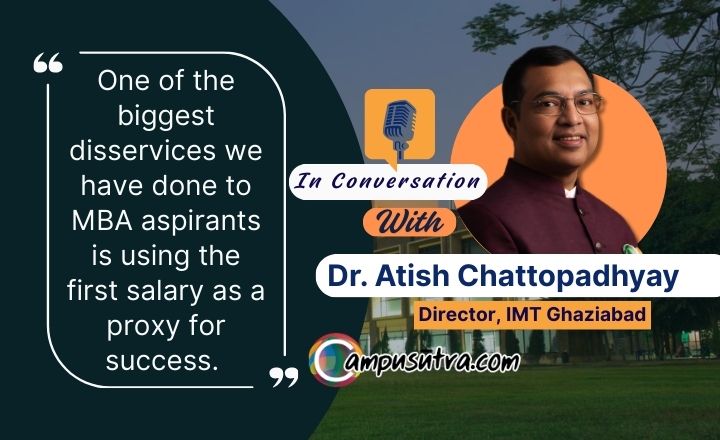
ROI in education is infinite. One of the biggest disservices we have done to MBA aspirants is using the first salary as a proxy for success. An MBA unlocks networks, expands potential, and provides a platform for long-term growth. It prepares individuals not just for their first role, but for a lifetime of leadership.
6 : You mentioned how AI has been embedded in the curriculum and pedagogy at IMT G for students to learn and practice ‘specialisation specific AI tools – like AI in Marketing or in Supply Chain etc. How does this initiative move students from being mere users of AI to ‘AI-ready’ managers ?
The real question today is not “What can AI do?” but “What can humans and AI do together?”
At IMT Ghaziabad, AI is embedded within specialisations—marketing, finance, operations—so students learn domain-specific AI tools guided by faculty insight. This ensures students develop judgment, context, and critical thinking, not just tool familiarity.
The future MBA will fuse human wisdom with machine intelligence, creating leaders capable of thriving in an AI-augmented world.
7: As AI tools become part of everyday learning in B-Schools, do you see a paradigm shift from conventional knowledge-based assessments to an emphasis on prompt engineering and adaptive digital skills?
AI skills will simply become part of everyday work and learning. This is like learning how to use the internet when it became relevant some time back. The focus will naturally shift from static knowledge recall to application, judgment, and adaptability.
The Business School Landscape In India: Challenges & The Need For Global Visibility
8 : In an era dominated by AI and ML, many experts argue that the truly “secure” jobs of the future may lie in skill sets like plumbing, carpentry, or masonry …. areas where machines can’t easily replace human skill. Against this backdrop, how can an MBA education position itself to remain future-agnostic and resilient?
The future does not reward perfection—it rewards adaptability.
Management education must groom value-driven, globally resilient leaders who can navigate ambiguity, read weak signals, and inspire confidence amid uncertainty. This requires integrating geopolitical literacy, simulation-based learning, cross-cultural intelligence, and global partnerships.
Equally important are value-based interventions such as IMT Ghaziabad’s “I’M the Change” initiative, which exposes students to communities unlike themselves and instills a deep sense of purpose and responsibility which essentially on the long run makes one resilient.
9 : Sir, in 2023 we spoke to you on foreign universities setting up on Indian soil, you mentioned it would have any impact on premier Indian B-schools. Now that many foreign institutions are fully operational in Gift City and Delhi NCR, not much shift in the ‘aspirant mindset’ has been noticed when it comes to choosing between a legacy Indian Private Sector B School like – XLRI, MDI, SPJIMR, SIBM, NMIMS, IMT etc. However, students are paying hefty fees and enrolling in those Universities. How do you see this now as of Jan 2026 ? What transformation do you believe Indian B-Schools must embrace to stay competitive? Do you believe foreign universities in India are raising the bar or simply raising the fees?
India today has 14 B-schools in the Financial Times Top 100, including IMT Ghaziabad. Most foreign universities operating in India are not comparable in academic standing or alumni depth to top Indian institutions.
Top aspirants will continue to prefer leading Indian B-schools, and top recruiters will continue to hire from them. Legacy, relevance, and outcomes will continue to matter.
10 : You’ve advocated for moving away from the ‘Mela Model’ of recruitment and once said ‘Most B Schools have become placement agencies’ and we too feel primarily ROI and Placement figures tend to dominate the attention of Campusutra.com readers. At IMT Ghaziabad, how are you working to redefine this narrative, ensuring management education is seen as a transformative journey rather than just a placement outcome?
We are moving from a generic placement model to a role-competency-based approach. Our Role-Competency Playbook links academic learning directly to career outcomes.
Students begin with the role they aspire to and work backwards—identifying competencies, skills, and courses required. This makes learning purposeful, focused, and self-directed, ensuring graduates are industry-ready from Day Zero.
11 : And when it comes to admissions, what are the two most crucial traits looked for in an applicant during the interview process at IMT Ghaziabad ? And how is IMT getting recruiters to look beyond the CGPA?
There is a clear strategic shift in IMT Ghaziabad’s placement philosophy. We are moving away from a generic placement approach to a niche, role–competency–based model.
Today, companies recruit for roles, not functions. The job description is for a performance marketer or an investment banker, not for a generic marketing or finance professional. This is fundamentally different from the earlier campus recruitment model, which largely revolved around broad “management trainee” profiles.
Under the role-competency approach, students self-select into roles. For instance, a student preparing for a Marketing Analyst role will not apply to a position seeking an Area Sales Manager. This ensures that recruiting partners engage only with candidates who are both interested in and prepared for the role.
As a result, recruiters no longer need to sift through a large number of look-alike CVs or conduct extensive interviews to identify fit. This significantly reduces time to recruit. Further, when a candidate with the right behavioural orientation builds the required technical and functional competencies for a specific role, the recruiter also saves on time to train and deploy. Such candidates are capable of performing from Day Zero.
In essence, the role–competency-based model addresses three critical recruiter pain points:
- Time to Recruit
- Time to Deploy
- Time to Perform
From an admissions perspective, our faculty increasingly evaluate aspirants through the lens of a potential recruiter—assessing which roles the candidate is likely to succeed in, their willingness to learn, and their ability to create a self-development agenda for a successful career as a management professional.
On behalf of the Campusutra.com editorial team, I extend our heartfelt thanks for this opportunity. True to your nature, you remained candid, spontaneous and engaging as always. We deeply appreciate the time and thought you invested in the conversation. It is voices like yours that inspire students, educators, and us all, alike.
For MBA Aspirants 2026 – Note that IMT is closing applications on Jan 26th, 2026 at 11:59 PM. Apply if you have already not done so.