


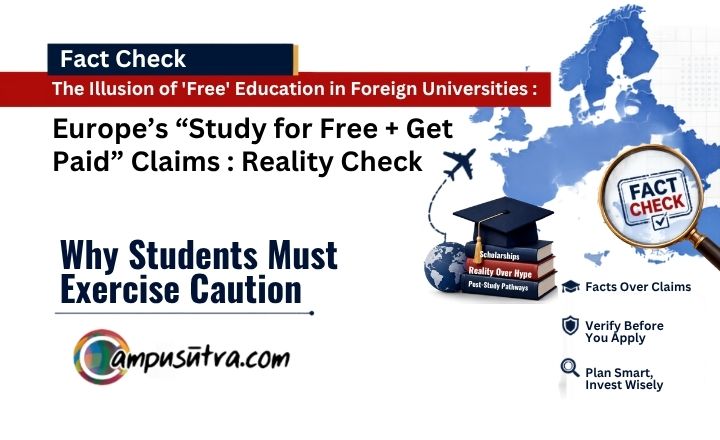
Editor Campusutra Aug 24th 2026 : While headlines and viral social media posts frequently promote “free education abroad,” prospective international students must recognize that absolute zero-cost education is a myth. Even in destinations or programs where tuition fees are waived or covered by competitive scholarships, significant expenses—such as monthly living costs, mandatory health insurance, visa application fees, flight tickets, and administrative administrative levies—remain the sole responsibility of the student. Furthermore, relying blindly on claims of “free study” often leads applicants to overlook strict eligibility criteria, aggressive admission deadlines, and expensive currency conversion rates. Falling for the lure of “free study abroad” without conducting thorough financial planning can lead to severe budget shortfalls mid-course. Students should treat study-abroad opportunities not as a free giveaway, but as a strategic investment that requires verifying institutional costs, evaluating living expenses, and preparing for real-world financial commitments.
With Foreign Universities setting up campuses in India, Is Liberalization of the education sector coming up?
Social-media claims about European universities not only teaching Indian students Artificial Intelligence and SpaceTech but also paying them to study, while offering a route to remain in Europe after graduation, has attracted attention recently among Indian students.
At least 30 Foreign Universities expected to open campuses in India
There is some amount of truth behind the above claim however some of the numbers and immigration claims circulating online are either overstated, incomplete or simply wrong.
Team Campusutra reviewed the latest official information available as of August 23, 2026. Here is what students need to know.
Konrad Zuse Schools of Excellence in Artificial Intelligence, Germany
Claim : Germany’s DAAD-backed Konrad Zuse Schools offer funded AI opportunities, Erasmus Mundus offers highly competitive full scholarships, and countries such as Germany, France and Luxembourg have post-study employment pathways.
There is a substantial amount of truth behind this. Germany’s DAAD-backed Konrad Zuse Schools do offer funded AI opportunities,
Erasmus Mundus offers highly competitive full scholarships, and countries such as Germany, France and Luxembourg have post-study employment pathways.
One specific programme, the Konrad Zuse School of Excellence in Reliable Artificial Intelligence (relAI), currently lists 15 Master’s scholarships. The scholarship is for up to 24 months and provides a monthly allowance of around €934. Applicants must be highly qualified and, according to the DAAD listing, have been accepted into an appropriate programme at TUM or LMU. (DAAD)
However, students should note an important 2026 update: the relAI Master’s call for 2026 had an application deadline of June 15, 2026.
Therefore, students reading the viral post today should not assume that this particular 2026 scholarship is still open. (Zuse School Relay)
All about International MBA programs
The broader Zuse Schools network continues to operate, so prospective applicants should monitor new calls rather than treating the 2026 relAI intake as an always-open opportunity.
Claim : Another claim that stands up to scrutiny is Germany’s post-study employment route.
According to the German government’s official “Make it in Germany” portal, third-country graduates can obtain a residence permit for up to 18 months to look for qualified employment. During this period, they can take up employment while searching for their long-term professional opportunity. (Make It In Germany)
But the claim goes too far when it suggests that this simply converts into an EU Blue Card.
A Blue Card requires a qualifying job and the applicant must satisfy the applicable conditions. It is therefore better described as a possible next immigration step after securing an eligible job, rather than an automatic conversion. (Make It In Germany)
Erasmus Mundus: Genuine Opportunity, Wrong Numbers
The European Commission confirms that Erasmus Mundus Joint Masters are international Master’s programmes delivered by consortia of higher education institutions. An EMJM involves at least three higher education institutions from three different countries, with students typically studying in more than one country. (Erasmus+)
Full scholarships are available to the best-ranked students worldwide. They cover participation costs and contribute towards travel, visa and living expenses. (Erasmus+)
The current EU framework specifies a scholarship of €1,400 per month for a maximum of 24 months. (Erasmus+)
Therefore, saying that an Erasmus Mundus scholarship is “worth roughly ₹50 lakh” is not an accurate way to report the official scholarship. The monthly scholarship component alone works out to €33,600 over 24 months; additional covered costs depend on the programme and scholarship structure.
Claim : There are “200+ fully funded scholarships”
The EU does not present Erasmus Mundus as a single annual pot of 200 scholarships available to every applicant. Scholarship availability is linked to individual Master’s programmes which essentially means it also needs qualification.
Importantly for students planning ahead, the European Commission says most Erasmus Mundus applications are generally submitted between October and January for courses beginning in the following academic year. (Erasmus+)
There is also fresh evidence that the programme is expanding. In July 2026, the European Commission announced 37 new Erasmus Mundus Joint Masters selected under the latest call. These new programmes are expected to open applications in autumn 2026 for programmes beginning in September 2027. Several have AI, data, semiconductor and advanced-technology themes. (Erasmus+)
Claim : France offers post-study route for eligible international Master’s graduates for 24-Month
France does offer an attractive post-study route for eligible international Master’s graduates. But the current official French government information states that the job-search/business-creation residence permit allows an eligible graduate to remain in France for one year. It is not renewable. (Service Public)
The permit can be used to search for employment or establish a business related to the graduate’s studies or research. If the graduate secures qualifying employment, they can then apply for an appropriate professional residence status. (Service Public)
So the statement “France offers up to 24 months” can not be held valid without a very specific legal exception or context.
Luxembourg: Opportunity Exists, But It Is 12 Months
Similarly, Luxembourg also offers a post-study option, but again the viral post exaggerates the duration.
The Luxembourg government’s official portal states that eligible third-country students who complete a Master’s degree or PhD can apply for a residence permit to look for a job or establish a business. (Guichet Public)
The permit is valid for 12 months, and employment or self-employment must relate to the student’s academic education. (Guichet Public)
So Luxembourg is a genuine post-study destination, but the claim of a 24-month job-search period is incorrect.
What Indian Students Should Take Away
The bigger story behind the viral post is actually more interesting than the exaggerated numbers.
Europe does have a growing ecosystem of international Master’s programmes, scholarships and post-study employment routes. Germany’s AI-focused Zuse Schools are a genuine example. Erasmus Mundus remains one of the strongest fully funded international Master’s opportunities available to students worldwide. France and Luxembourg offer legitimate post-study pathways, while Germany’s 18-month job-search provision is particularly notable.
But “free Master’s + €1,000 monthly stipend + guaranteed European job + permanent settlement” is not the reality.
Students need to distinguish between four separate things:
- Admission to a university or Master’s programme.
- Scholarship selection, which may be highly competitive.
- Post-study job-search rights, which vary by country.
- Long-term residence, which requires additional immigration conditions.
A scholarship does not automatically guarantee employment. A job-search permit does not guarantee a job. And a post-study work route does not automatically mean permanent residence.
Myth Buster: What is True and What is Misleading?
| Claim circulating online | Verdict | Campusutra fact-check |
| European universities are “paying Indians to study AI and SpaceTech” | Misleading | There are funded opportunities for international students, including AI-related programmes. However, these are competitive scholarships and cannot be described as Europe broadly “paying Indians” to study. The SpaceTech claim is also too broad based on the programmes verified. |
| Germany’s Konrad Zuse Schools offer AI scholarships | True | DAAD confirms that its Konrad Zuse Schools provide research-based AI training at Master’s and PhD level and bring together universities, research institutions and companies in Germany. |
| Zuse offers 15–20 fully funded Master’s scholarships | Partly true | The DAAD’s current listing for the relAI Master’s scholarship specifies 15 scholarships, not 15–20. The scholarship runs for up to 24 months. |
| Zuse scholarship provides about €1,000 per month | Nearly true | The current DAAD listing specifies a monthly allowance of €934, not €1,000. It is therefore reasonable to call it “about €1,000”, but the precise figure should be reported as €934. |
| Students can study through the Zuse relAI programme at TUM or LMU | True | DAAD states that eligible Master’s students must already have been accepted into an appropriate programme at TU Munich or LMU. |
| Germany allows international graduates 18 months to find a job | True | Third-country graduates can obtain a residence permit for up to 18 months to look for qualified employment. They may work during this period, subject to the applicable rules. |
| The German post-study permit automatically becomes an EU Blue Card | Misleading | A Blue Card is not automatic. A graduate needs a qualifying employment offer and must satisfy the Blue Card conditions. |
| Erasmus Mundus offers 200+ fully funded scholarships | Unsupported as stated | Erasmus Mundus does offer full scholarships to highly ranked students worldwide, but the official 2026 information does not support a blanket claim that “200+ scholarships” are available to every intake. Scholarship numbers vary by programme and call. |
| Every Erasmus Mundus scholarship is worth around ₹50 lakh | Misleading | The current EU framework specifies a scholarship of €1,400 per month for a maximum of 24 months. Erasmus scholarships also cover/contribute towards participation, travel and visa-related costs depending on the programme. The total financial value should therefore not be presented as a fixed ₹50 lakh cash scholarship. |
| Erasmus Mundus programmes cover countries such as Italy, Spain, Netherlands and Slovenia | Broadly true | Erasmus Mundus is specifically designed around international university consortia and study periods in multiple countries. The exact countries depend on the individual Master’s programme. |
| Erasmus programmes are generally taught in English | Programme-dependent | Many Erasmus Mundus programmes are taught in English, but students must check the language requirements of the specific programme. “All courses are in English” is too broad. |
| France allows Master’s graduates up to 24 months to search for jobs | False | France’s official rules currently provide a one-year job-search/business-creation residence route for eligible Master’s-level graduates. The permit is not renewable. |
| Luxembourg lets graduates remain after a Master’s to find a job | True | Luxembourg allows eligible third-country Master’s and PhD graduates to apply for a residence permit to look for employment or start a business. |
| Luxembourg provides 24 months for job search | False | The official Luxembourg government portal states that the job-search/business-creation residence permit is valid for 12 months. |
| Studying in these countries gives students a guaranteed route to permanent residence | Misleading | Post-study work routes can create a pathway to longer-term residence, but permanent residence is not automatic. Graduates must meet the relevant employment, residence and immigration requirements. |
Campusutra Verdict
Opportunity is real. The numbers need a reality check.
For Indian students, the message should not be interpreted as “Europe will pay you to study.”
The more accurate message is:
Europe has some highly competitive programmes where international students can receive substantial financial support to pursue advanced Master’s degrees, including AI and other emerging technologies while countries such as Germany offer meaningful post-study pathways for graduates who successfully are into any profession.
Disclaimer : Students should actually fact check every detail with the concerned University and the authority of the country and not believe whatever is being told. Verify every source of information and rely on the latest update as what may be once true may not hold good after a certain period of time.


