


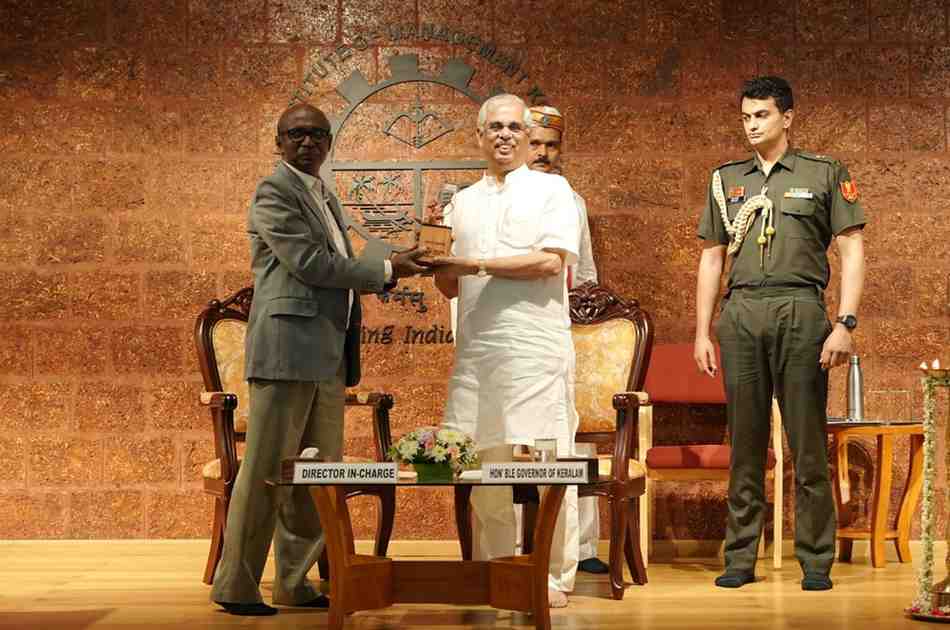
June 02, 2026 | Kozhikode: Hon’ble Governor of Kerala, Shri Rajendra Vishwanath Arlekar, on Jun 02 interacted with the visiting Yuva Sangam Phase VI delegation from Jammu, Kashmir and Ladakh at the Indian Institute of Management Kozhikode (IIMK), underscoring the importance of youth-led cultural exchange in strengthening national integration and fostering a deeper understanding of India’s diversity.
Addressing the 33-member delegation at the IIM Kozhikode campus, the Governor highlighted the significance of the Government of India’s Yuva Sangam initiative under the Ek Bharat Shreshtha Bharat programme, describing it as a powerful platform for building emotional bonds among the youth of the country.
“Whenever India unites, India progresses. This is the essence of Ek Bharat Shreshtha Bharat,” Shri Arlekar remarked. He noted that programmes such as Yuva Sangam provide young citizens an invaluable opportunity to  learn from the strengths, achievements and best practices of different states and adapt those learnings in their own regions, however small the beginning may be.
The Governor encouraged the delegates to look beyond tourism and experience the culture, traditions, history and developmental achievements of the states they visit. He urged the participants to absorb the values and practices they encounter during the exchange and become catalysts of positive change upon returning home.
Reflecting on Kerala’s achievements, Shri Arlekar commended the state for its accomplishments in literacy, healthcare, social development and preservation of cultural heritage. Describing Kerala as a state that truly lives up to its reputation as “God’s Own Country,” he observed that despite its geographical size, Kerala has emerged as a model for other states in several developmental indicators.
The Governor also drew attention to Kerala’s efforts in balancing economic growth with environmental conservation. He stressed the importance of maintaining ecological balance while pursuing development and praised the state for preserving its cultural and natural heritage even while accommodating significant tourism activity. Sustainable growth, he noted, should remain a priority for every state in the country.
Invoking the historic journey of Adi Shankaracharya from Kerala to Kashmir, Shri Arlekar highlighted the civilisational and cultural connections that have bound the nation together for centuries. He said the spiritual philosopher’s travels symbolised India’s enduring unity amidst diversity and demonstrated how cultural exchange has historically strengthened national cohesion. Emphasising the importance of cultural understanding, self-reliance and environmental responsibility, the Governor encouraged the delegates to become ambassadors of India’s unity in diversity. He urged them to recognise and nurture the spirit of “Bhartiyata”—the intrinsic sense of Indianness that transcends regional, linguistic and cultural differences.
The interactive session witnessed enthusiastic participation from the delegates from Jammu, Kashmir and Ladakh, who engaged with the Governor on topics ranging from education and cultural preservation to sustainable development and national integration.
The Governor was welcomed by Prof. Sebastian M.P., Director-in-Charge and Dean (Faculty Administration & Research), IIM Kozhikode, who highlighted the institute’s commitment to supporting initiatives that promote national integration, experiential learning and cultural exchange among youth.
The Jammu, Kashmir and Ladakh delegation comprising 33 young participants arrived at IIM Kozhikode as part of the exchange leg of Yuva Sangam Phase VI. IIM Kozhikode is hosting the delegation in partnership with IIM Jammu under Phase VI of Yuva Sangam, an initiative of the Ministry of Education under the Ek Bharat Shreshtha Bharat programme. The initiative aims to strengthen people-to-people connections among youth from different regions of India through immersive exposure visits and cultural exchange.
As the host institution, IIM Kozhikode has curated an intensive seven-day itinerary covering the five pillars of Yuva Sangam—Paryatan (Tourism), Parampara (Traditions), Pragati (Development), Prodyogiki (Technology), and Paraspar Sampark (People-to-People Connect).
During the first four days of their visit, the delegates explored Kerala’s natural beauty, cultural heritage and developmental institutions through visits to the Chaliyar River, Ponmala and Ponpara hills, Tali Mahakshetram, Kozhikode Beach, Sargaalaya Arts & Crafts Village, Kappad Beach, the National Institute of Technology Calicut, the Centre for Water Resources Development and Management (CWRDM), and the Regional Science Centre and Planetarium. The remaining days of the programme will include visits to Nilambur, Wayanad and several other prominent destinations across northern Kerala.
Through these experiences, the delegates continue to discover Kerala through the lens of the five pillars of Yuva Sangam while building friendships, fostering mutual understanding and strengthening the spirit of Ek Bharat Shreshtha Bharat.


