


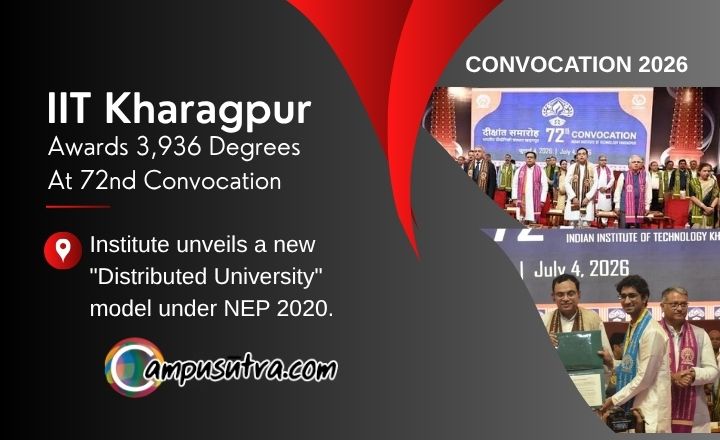
KHARAGPUR: IIT Kharagpur, India’s first Indian Institute of Technology and an officially recognized Institute of Eminence (IoE), celebrated its 72nd Annual Convocation by conferring an impressive 3,936 degrees across undergraduate, postgraduate, doctoral, and professional programs.
Engineering Entrance Exam 2026 -2027. B Tech last date and Application Fees
The convocation highlighted the institute’s aggressive pivot toward the National Education Policy (NEP) 2020 and its massive structural transformation into a “distributed university” aimed at national capacity building.
The Metrics: Breakdown of the 3,936 Degrees Conferred
Demonstrating its massive scale as a multidisciplinary education hub, the graduation metrics span cutting-edge research, core engineering, law, and corporate management:
| Academic Programme | Degrees Awarded |
| Ph.D. (Doctoral) | 539 |
| M.Tech. | 908 |
| Dual Degree | 801 |
| B.Tech. (Honours) | 628 |
| Two-Year M.Sc. | 209 |
| Four-Year B.S. | 181 |
| MBA (Management) | 163 |
| LL.M. (Law) | 73 |
| PGDBA | 59 |
| LL.B. | 31 |
Academic Innovation & NEP 2020 Implementation
Addressing the convocation, Director Dr. Suman Chattopadhyay and Professor Suman Chakraborty outlined how the institute has successfully institutionalized the academic flexibility mandated by NEP 2020:
- Academic Bank of Credits (ABC): More than 14,285 students have created ABC IDs, with over 11,275 already validated to ensure seamless credit mobility.
- Interdisciplinary Flexibility: Double-major enrollments have crossed the 100-student milestone. Additionally, 25 micro-specializations spanning engineering, law, and entrepreneurship are now accessible alongside academic minors across all departments.
KIIT University vs Christ University vs Chandigarh University vs Hindustan Institute
GITAM, KLE, Aditya, or Anurag? A Comprehensive Comparison for 2026
Redefining Outreach: The ‘Distributed University’ Model
A central highlight of the reporting year is IIT Kharagpur’s strategic shift to democratize premier technical education through its newly conceptualized Outreach Course Network (OCN).
IIT Ropar B Tech Placements: Steady Growth with ₹23.07 LPA Average CTC
IIT Madras held its 62nd Convocation. 3,227 students were conferred degrees
“The Institute has consciously embraced the vision of becoming a distributed university whose intellectual influence extends well beyond its academic boundaries. Outreach is no longer perceived as an auxiliary function but as a strategic instrument for democratizing excellence,” noted the leadership.
The Outreach Course Network (OCN) Blueprint
- Institution-to-Institution Model: Unlike conventional mass open online courses (MOOCs) targeting solo learners, the OCN establishes structural partnerships directly with regional colleges.
- Credit-Compatible Curricula: Partner colleges receive structured learning frameworks under direct IIT faculty mentorship, academic supervision, and verified credit systems.
- Scalable Infrastructure: During the reporting year, 23 micro-specializations involving more than 15 academic units were developed, building a scalable web designed to connect hundreds of higher educational institutions back to IIT Kharagpur’s hub.
BREAKING NEWS: Amrita University Opens B Tech Admissions via JEE Main for Faridabad & Haridwar Campuses
DTU Concludes 2026 Placement Drive: Impressive Average Offers Maintained
Rebuilding Regional Ecosystems
The convocation also served as a platform to address higher education gaps in West Bengal. Highlighting challenges within state university infrastructures—including low Gross Enrolment Ratios (GER) and structural constraints—leadership emphasized a collaborative mentorship model.
Through sharing best practices in curriculum design, faculty development, internationalization, and innovation ecosystems, premier hubs like IIT Kharagpur aim to actively nurture emerging regional institutes. Furthermore, upcoming developmental visions include establishing new premier hubs, such as a dedicated fashion designing institute in North Bengal.


